An ABM strategy is a B2B go-to-market approach that concentrates sales and marketing resources on a defined set of high-value accounts instead of casting a wide net across the entire market. It replaces broad lead generation with coordinated, account-specific campaigns built around firmographic fit, buying intent, and revenue potential. Done correctly, an ABM strategy shortens sales cycles, raises deal size, and aligns marketing output directly with pipeline and revenue targets.
For years, B2B marketers chased volume: more leads, more form fills, more names in the CRM. But volume rarely translated into revenue, especially when only a handful of accounts actually had the budget, authority, and need to buy. That gap between activity and outcome is exactly what account-based marketing was built to close. Organizations that invest in a well-executed B2B marketing program built around ABM principles consistently report tighter sales-marketing alignment and higher win rates on strategic accounts.
This guide walks through the full lifecycle of an ABM strategy – from selecting the right accounts to turning those accounts into closed revenue – along with the mistakes that derail most programs and the practical tips that separate high-performing ABM teams from the rest.
What is an ABM Strategy? A Quick Definition
An ABM strategy treats individual accounts, not individual leads, as the unit of marketing. Instead of generating thousands of leads and hoping a percentage convert, teams identify a shortlist of accounts that match an ideal customer profile and build coordinated campaigns aimed at every relevant stakeholder inside that account.
In short: ABM strategy = precision over volume, account over individual, and revenue over raw lead count.
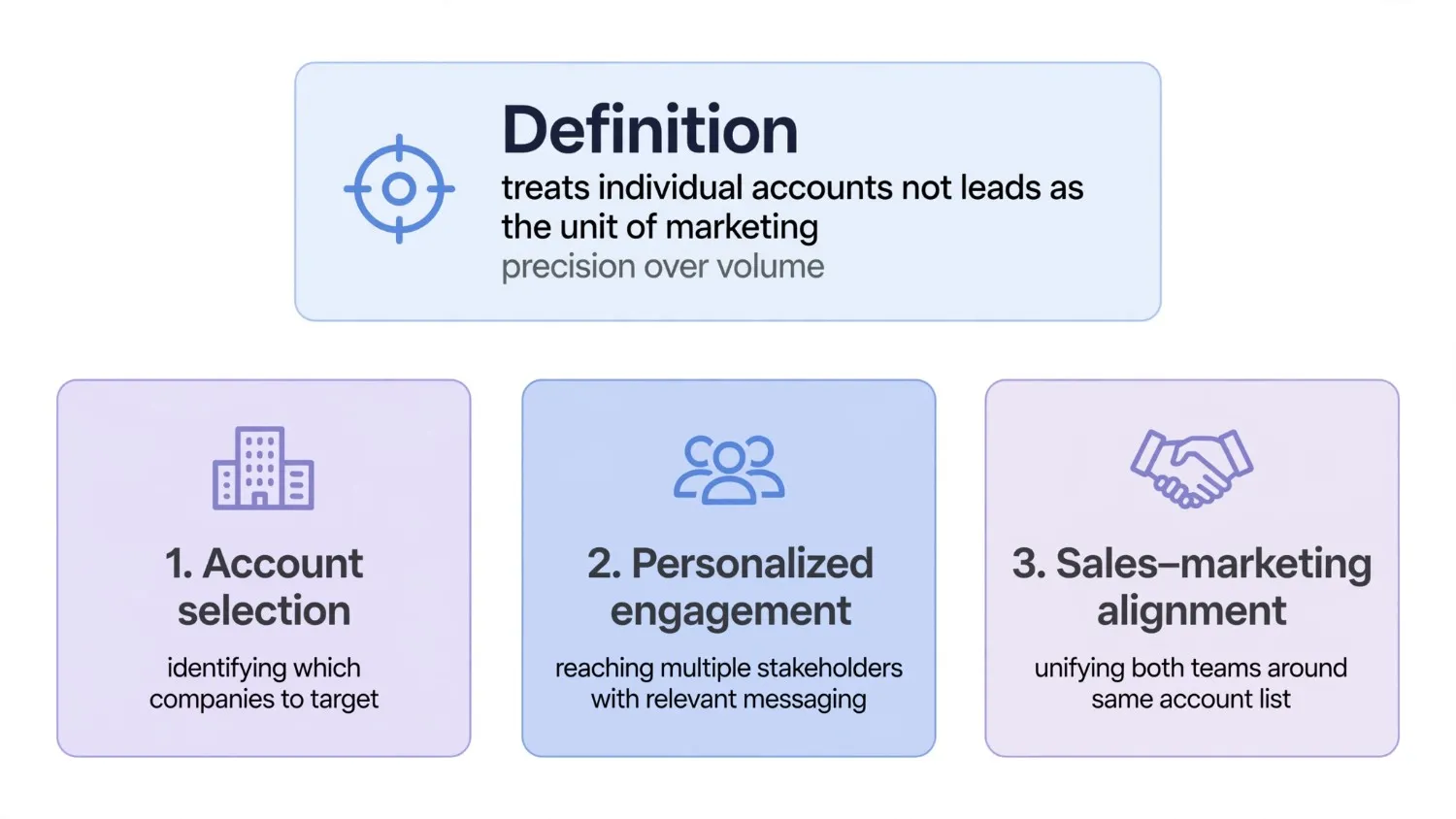
Three core elements define any ABM strategy:
- Account selection: identifying which companies to target
- Personalized engagement: reaching multiple stakeholders with relevant messaging
- Sales-marketing alignment: unifying both teams around the same account list and success metrics
Why an ABM Strategy Matters for Modern B2B Growth
B2B buying committees have grown larger and more complex. Most enterprise purchases now involve multiple decision-makers across departments, which means a single lead rarely controls the outcome of a deal. An ABM strategy accounts for this reality by engaging the full buying group rather than a single contact.
Key reasons ABM strategy has become a priority for growth-focused teams:
- Higher deal values: targeting accounts with genuine budget and fit increases average contract value
- Shorter sales cycles: engaging multiple stakeholders early reduces stalled deals later
- Better marketing ROI: spend concentrates on accounts most likely to convert, not on unqualified traffic
- Stronger sales-marketing alignment: both teams work from a shared account list and shared revenue goals
- Improved customer retention: the same personalized approach used to win accounts also supports expansion and renewal
Industry research from organizations like the ITSMA has repeatedly shown that ABM programs deliver higher ROI than broader demand generation efforts when targeting is disciplined and cross-functional alignment is strong.
Step 1: Account Selection – The Foundation of Any ABM Strategy
Account selection is the single most important decision in an ABM strategy. Get it wrong, and even flawless execution won’t produce revenue, because the campaigns are pointed at the wrong companies.
Building Your Ideal Customer Profile (ICP)
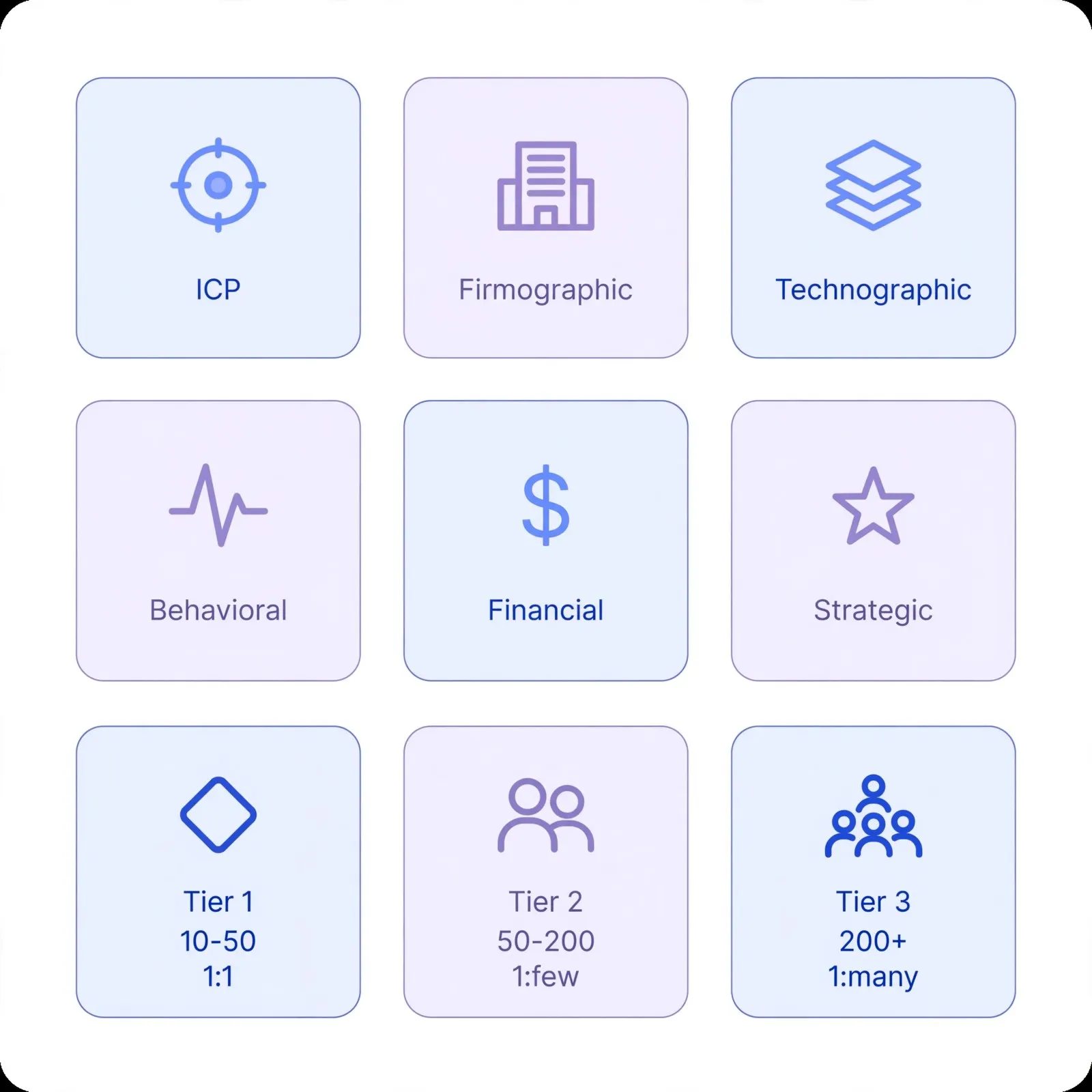
Before selecting individual accounts, define the ideal customer profile that describes your best-fit customers. A strong ICP typically includes:
- Firmographic data – industry, company size, revenue, geography
- Technographic data – existing tech stack and tools in use
- Behavioral signals – website visits, content downloads, search intent
- Financial indicators – budget availability, funding stage, growth trajectory
- Strategic fit – alignment with your product roadmap and long-term positioning
Scoring and Tiering Accounts
Once the ICP is defined, score prospective accounts against it and organize them into tiers. Most mature ABM strategy frameworks use a three-tier model:
| Tier | Account Volume | Personalization Level | Typical Approach |
|---|---|---|---|
| Tier 1 | 10–50 accounts | Fully 1:1 personalized | Custom content, executive outreach, dedicated campaigns |
| Tier 2 | 50–200 accounts | 1:few, segmented | Industry or persona-based clusters with tailored messaging |
| Tier 3 | 200+ accounts | 1:many, programmatic | Scaled digital campaigns with light personalization |
This tiering keeps resource allocation realistic. Tier 1 accounts justify heavy manual effort; Tier 3 accounts rely on automation and programmatic advertising to stay efficient.
Using Intent Data to Prioritize
Firmographic fit alone doesn’t tell you when an account is ready to buy. Layering in intent data – such as third-party research activity, competitor comparisons, or surges in relevant search behavior – helps prioritize which accounts to approach first. Accounts showing both strong fit and active intent should move to the top of the outreach queue.
Step 2: Building Your ABM Strategy Framework
With accounts selected, the next phase is building the campaign framework that will engage them. This is where marketing and sales must work from a single, shared plan.
Choose the Right ABM Model
There are three common ABM strategy models, and most companies run a blend of all three:
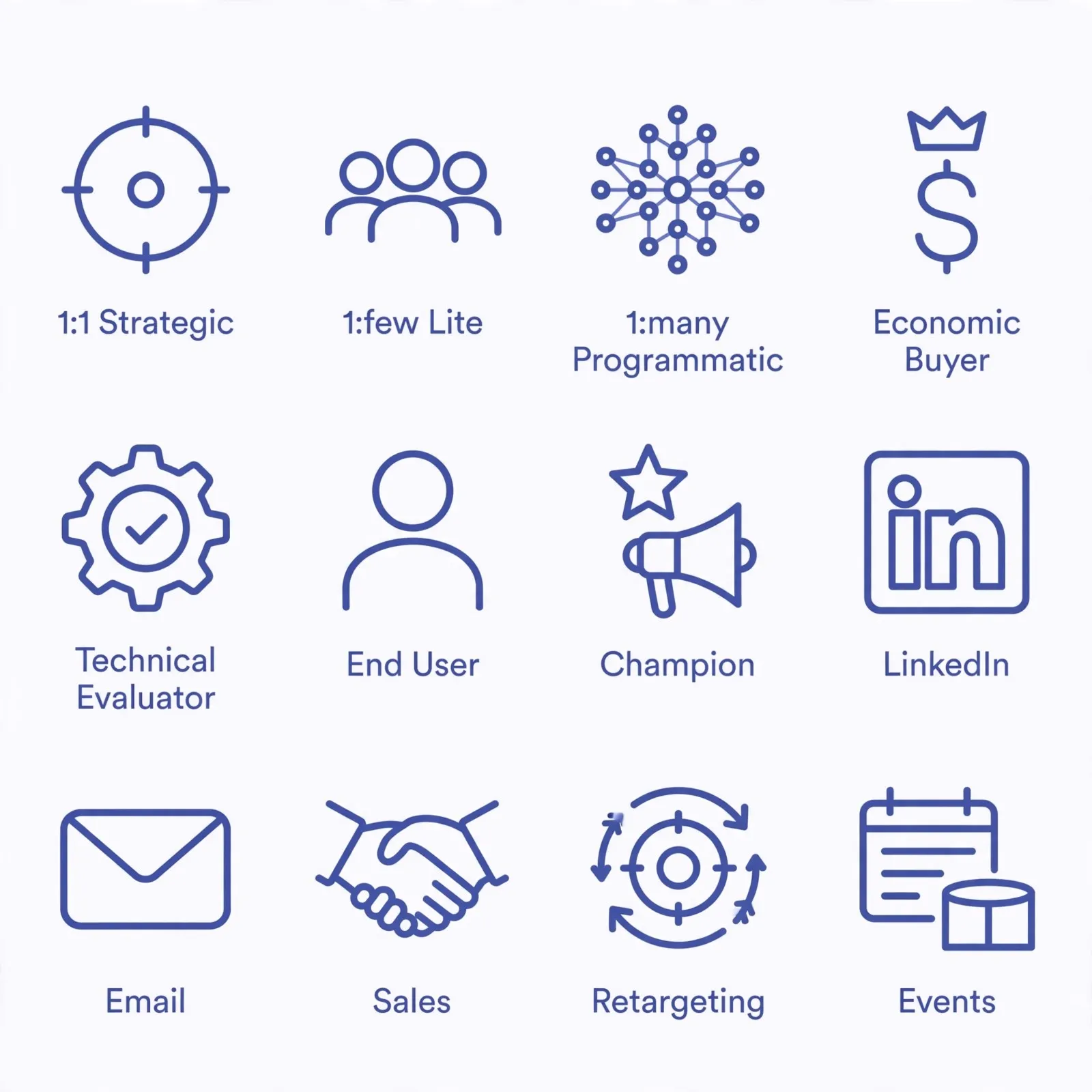
- Strategic (1:1) ABM: deep personalization for a small number of high-value accounts
- Lite (1:few) ABM: segmented campaigns for clusters of similar accounts
- Programmatic (1:many) ABM: scaled, technology-driven campaigns across a broader account list
Map Stakeholders Within Each Account
Enterprise deals rarely close through one contact. Map out the buying committee for each target account, including:
- Economic buyers who control budget
- Technical evaluators who assess product fit
- End users who will interact with the solution daily
- Influencers and champions who advocate internally
Create Account-Specific Content and Messaging
Generic content underperforms in ABM because buying committees expect relevance. Effective content assets for an ABM strategy include:
- Custom landing pages referencing the account’s industry or challenges
- Personalized email sequences tied to specific pain points
- Executive briefing documents for economic buyers
- Case studies from similar companies or verticals
- Interactive ROI calculators tailored to the account’s scale
Teams building demand programs alongside ABM often pair this account-specific content with a broader B2B demand generation strategy so that top-of-funnel awareness continues to feed the ABM pipeline over time.
Coordinate Multi-Channel Orchestration
A single email will not move an enterprise account through a long sales cycle. Successful ABM strategy execution typically layers several channels together:
- Targeted LinkedIn and programmatic display advertising
- Personalized email nurture sequences
- Direct sales outreach aligned to marketing touchpoints
- Retargeting based on account-level website engagement
- Executive events, webinars, or private briefings for Tier 1 accounts
Step 3: Aligning Sales and Marketing Around the ABM Strategy
Even a well-designed ABM strategy fails without sales-marketing alignment. This alignment needs to be structural, not just aspirational.
Shared Account Lists and Definitions
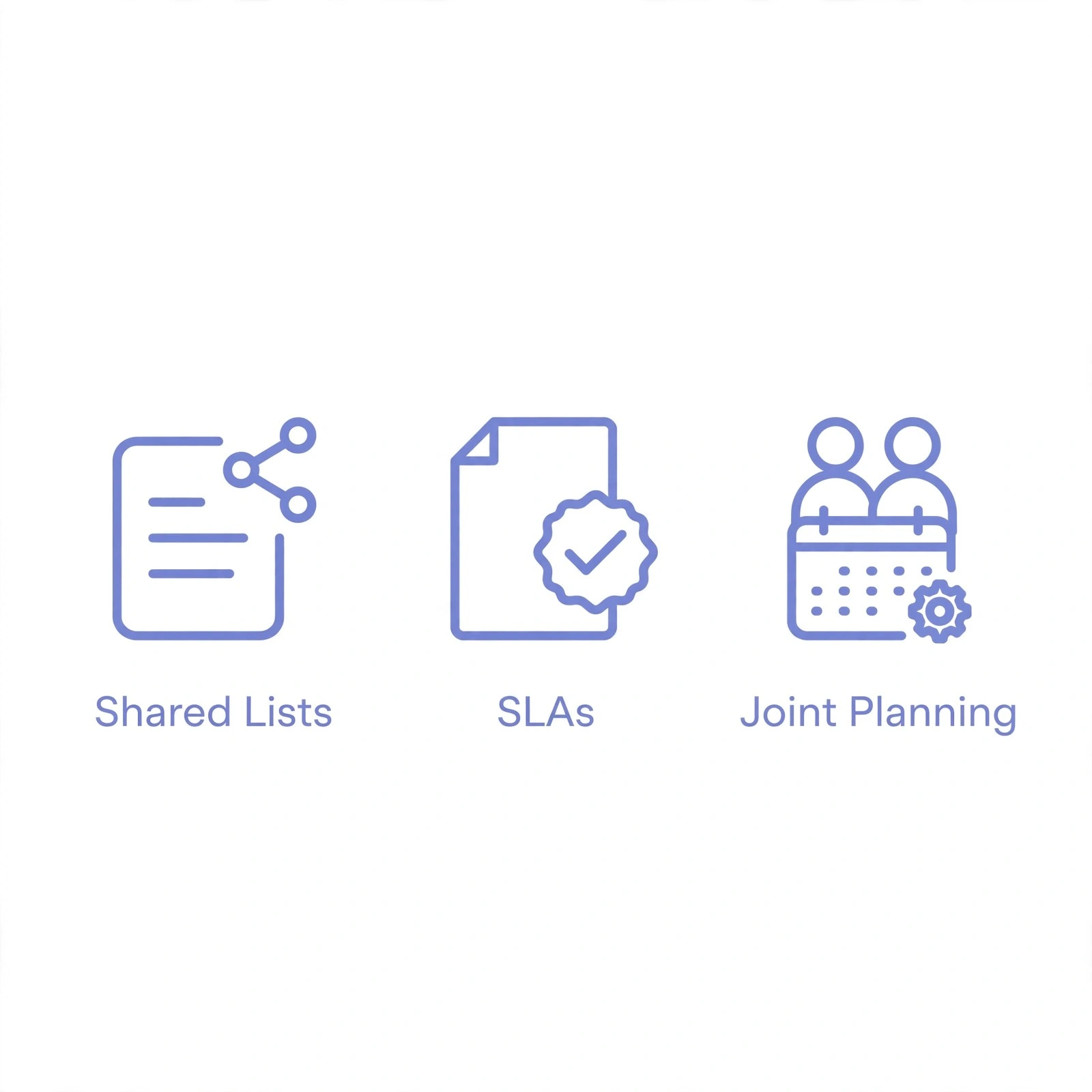
Sales and marketing must agree on exactly which accounts are in scope, and both teams should work from the same live list rather than separate spreadsheets. Disagreement here creates duplicated effort and inconsistent messaging.
Service-Level Agreements (SLAs)
Define what each team owes the other:
- Marketing commits to delivering qualified engagement signals within a set timeframe
- Sales commits to following up on marketing-flagged accounts within an agreed window
- Both teams commit to shared reporting on account progression
Joint Account Planning
For Tier 1 accounts especially, sales and marketing should build joint account plans that map the buying committee, outline the content and outreach cadence, and set milestones for the account’s progression through the funnel.
Teams still building foundational inbound programs alongside ABM can review this breakdown of B2B inbound marketing strategy to understand how inbound and account-based efforts complement each other rather than compete.
Step 4: Measuring ABM Strategy Performance and Revenue Generation
Traditional marketing metrics like total leads or website traffic don’t capture ABM performance accurately. Instead, ABM strategy success should be measured against account-level and revenue-level indicators.
Core ABM Metrics to Track
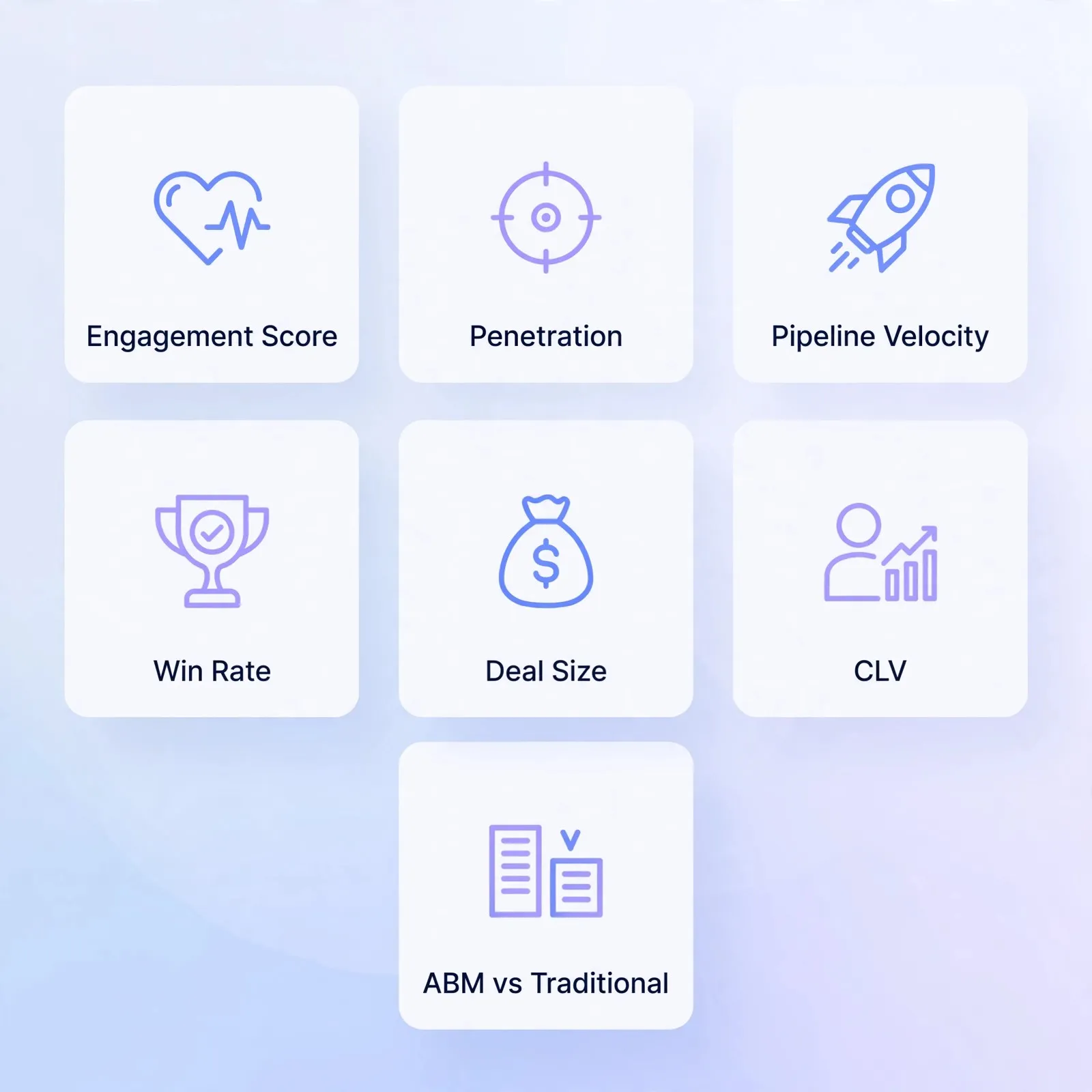
- Account engagement score: aggregated activity across all stakeholders in a target account
- Account penetration: percentage of the buying committee actively engaged
- Pipeline velocity: speed at which target accounts move through funnel stages
- Win rate on target accounts: percentage of engaged accounts that close
- Average deal size: contract value for accounts sourced or influenced by ABM
- Customer lifetime value (CLV): long-term revenue generated from won accounts
ABM Strategy vs. Traditional Demand Generation
| Factor | ABM Strategy | Traditional Demand Generation |
|---|---|---|
| Target unit | Named accounts | Broad audience segments |
| Content approach | Personalized per account | Generalized for scale |
| Sales involvement | Early and continuous | Typically after MQL handoff |
| Primary metric | Account engagement and revenue | Lead volume and conversion rate |
| Best suited for | High-value, complex B2B sales | High-volume, lower-ticket sales |
| Resource allocation | Concentrated on fewer accounts | Distributed across many prospects |
Frameworks published by analyst firms such as Gartner consistently note that revenue-focused ABM programs outperform lead-volume approaches specifically in complex, multi-stakeholder B2B sales environments.
Common Mistakes That Undermine an ABM Strategy
Even well-funded ABM programs stall when teams fall into predictable traps.
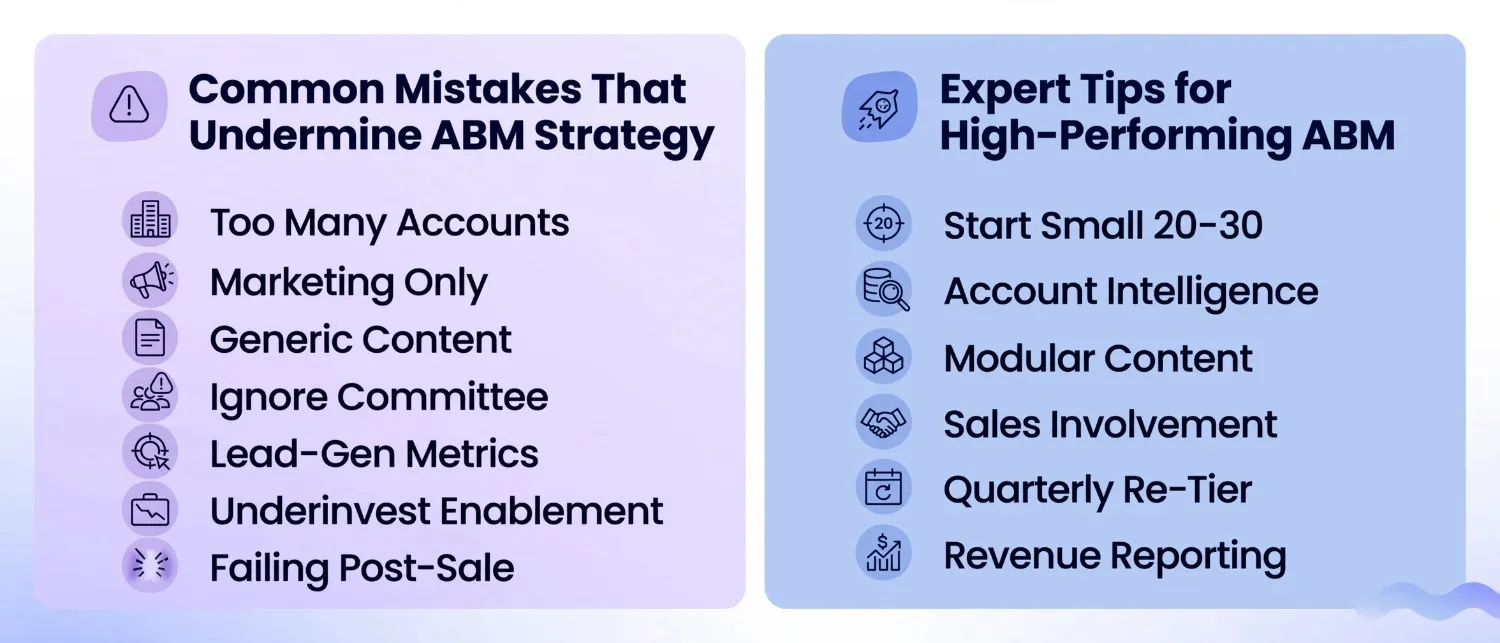
- Selecting too many accounts. Spreading resources across hundreds of accounts without proper tiering dilutes personalization and defeats the purpose of ABM.
- Treating ABM as a marketing-only initiative. Without sales buy-in from day one, engaged accounts stall at handoff.
- Using generic content and calling it “personalized.” Swapping in a company name is not personalization; messaging must reflect the account’s actual context.
- Ignoring the full buying committee. Focusing only on one champion leaves the deal vulnerable if that contact leaves or loses influence.
- Measuring success with lead-generation metrics. Applying MQL-based KPIs to an ABM strategy misrepresents actual performance.
- Underinvesting in sales enablement. Sales teams need account intelligence and talking points, not just a list of company names.
- Failing to sustain post-sale engagement. ABM strategy shouldn’t stop at the signed contract; expansion and renewal depend on continued account-level attention.
Expert Tips for a High-Performing ABM Strategy
- Start smaller than feels comfortable. A tightly scoped pilot with 20-30 well-selected accounts produces cleaner data than an oversized rollout.
- Invest in account intelligence tools early. Firmographic and intent data platforms make tiering and prioritization far more accurate than manual research alone.
- Build content in modular blocks. Modular messaging frameworks can be recombined for different accounts without rebuilding assets from scratch each time.
- Involve sales in account selection, not just execution. Reps often have context on account readiness that firmographic data alone won’t reveal.
- Review and re-tier accounts quarterly. Buying signals shift; an account that wasn’t ready six months ago may now be actively evaluating solutions.
- Report in revenue terms, not marketing terms. Framing results around pipeline and closed revenue keeps ABM strategy credible with leadership and finance.
Step-by-Step Summary: Launching an ABM Strategy
- Define your ideal customer profile using firmographic, technographic, and behavioral criteria
- Build and score a target account list, then organize accounts into tiers
- Layer in intent data to prioritize accounts showing active buying signals
- Map the buying committee within each target account
- Develop account-specific content and messaging for each tier
- Coordinate outreach across paid, email, direct sales, and event channels
- Establish sales-marketing SLAs and shared reporting
- Track account engagement, pipeline velocity, and revenue outcomes
- Re-tier and refine the account list on a recurring basis
- Extend the same personalized approach into post-sale expansion and renewal
Frequently Asked Questions
What is an ABM strategy in simple terms?
An ABM strategy is a B2B marketing approach that targets a specific list of high-value accounts with personalized campaigns, rather than marketing broadly to a general audience.
How is an ABM strategy different from traditional lead generation?
Traditional lead generation focuses on maximizing the number of individual leads, while an ABM strategy focuses on engaging entire buying committees within a smaller, carefully selected set of accounts.
How many accounts should a company target with an ABM strategy?
It depends on the ABM model used. Strategic (1:1) programs typically target 10-50 accounts, lite programs target 50-200, and programmatic ABM can scale to 200 or more accounts with lighter personalization.
What tools support an effective ABM strategy?
Common tools include intent data platforms, account-based advertising platforms, CRM and marketing automation systems, and sales intelligence software that together support account selection, engagement tracking, and reporting.
How long does it take to see results from an ABM strategy?
Given typically longer B2B sales cycles, most ABM programs need three to six months before meaningful pipeline and revenue results become visible, with continued improvement as account data and messaging are refined.
Does an ABM strategy replace demand generation entirely?
No. Most mature B2B organizations run ABM strategy alongside broader demand generation, using demand gen to build awareness and pipeline while ABM concentrates resources on the highest-value target accounts.
Conclusion
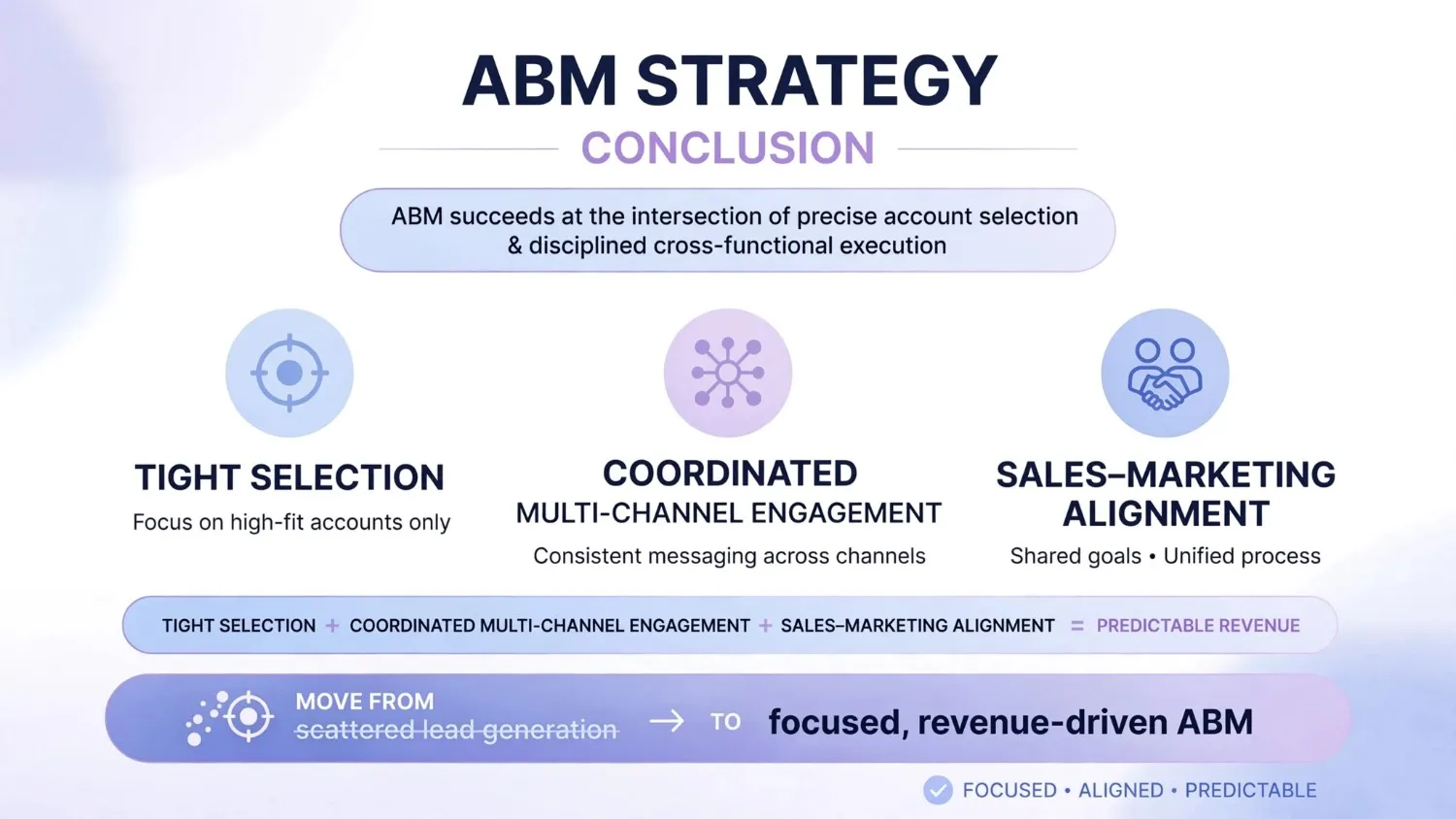
An ABM strategy succeeds or fails at the intersection of two disciplines: precise account selection and disciplined cross-functional execution. Companies that treat ABM as a targeting exercise alone tend to see modest results, while those that combine tight account selection, coordinated multi-channel engagement, and genuine sales-marketing alignment consistently turn strategic accounts into predictable revenue.
If your team is ready to move from scattered lead generation to a focused, revenue-driven ABM strategy,to build an account-based program tailored to your target market.