
A B2B inbound marketing strategy is a demand-generation methodology that attracts high-intent decision-makers through permission-based content assets – including SEO-optimized thought leadership, gated lead magnets, marketing-qualified lead (MQL) nurture sequences, and intent-driven conversion pathways – rather than interruptive outbound tactics. Unlike traditional outbound campaigns, inbound aligns your brand authority directly with the buyer’s self-directed research journey across awareness, consideration, and decision stages. When executed systematically, a well-structured B2B inbound marketing strategy compresses sales cycles, improves lead quality scores, and drives compounding organic pipeline growth that scales without proportional ad spend.
Most B2B organizations invest heavily in paid acquisition before ever building a sustainable inbound engine. That is an expensive mistake. In this guide, you will find a complete, stage-by-stage framework for building a B2B inbound marketing strategy that consistently generates qualified pipeline, builds long-term brand authority, and turns your website into your best-performing sales asset.
If you are looking for expert-led execution of everything covered in this guide, AAMEK’s B2B marketing services give growth-focused companies the strategic infrastructure, content systems, and demand-generation frameworks to compete and win.
What is B2B Inbound Marketing?
At its core, B2B inbound marketing is the practice of drawing potential buyers to your brand by delivering value at every stage of their research and decision-making process. Instead of interrupting prospects with cold calls, banner ads, or unsolicited emails, inbound creates a magnetic pull. You publish the right content, optimize it for organic discovery, and build trust before a sales conversation ever begins.
The term was popularized by HubSpot, and it has become the foundational philosophy behind modern demand generation. According to HubSpot’s State of Marketing Report, companies that prioritize inbound strategies consistently report lower cost-per-lead and higher close rates than those relying primarily on outbound.
Key difference from B2C inbound: B2B buying cycles are longer, involve multiple stakeholders, and carry higher financial stakes. Your inbound strategy must account for committee-based decision making, extended nurture timelines, and content that speaks to both technical evaluators and C-suite buyers simultaneously.
Why Inbound Marketing Works Differently in B2B
B2B buyers are not impulse purchasers. Before committing budget, they conduct extensive independent research – often completing 57% to 70% of their buying journey before ever contacting a vendor, according to Gartner’s B2B buying research.
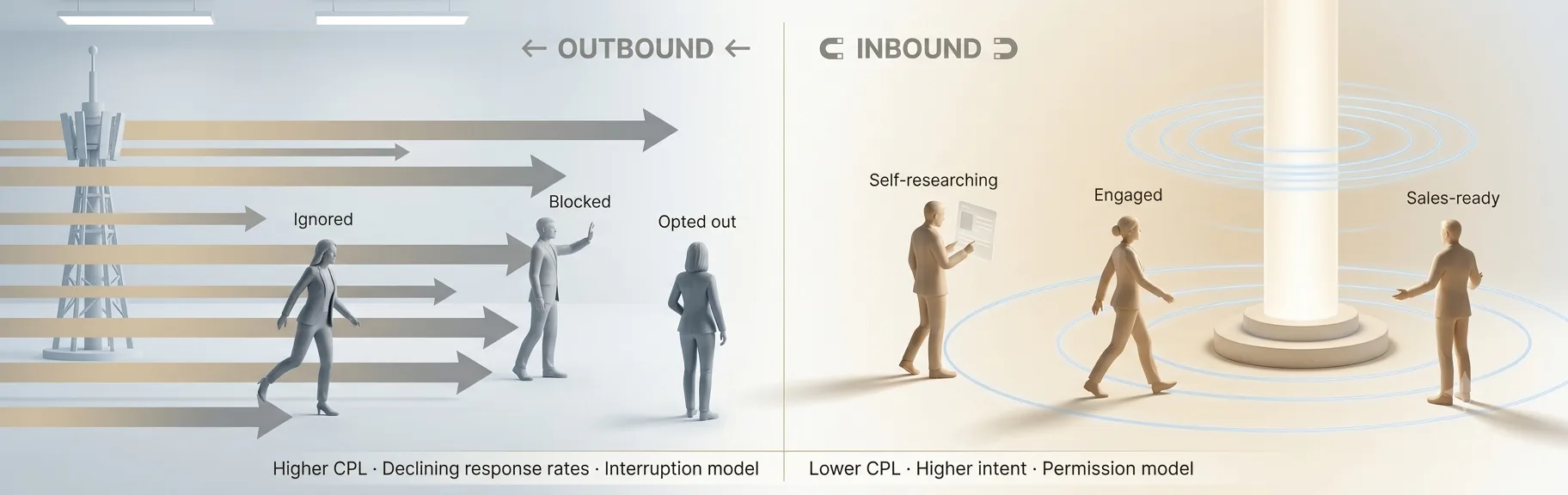
This behavioral reality makes inbound marketing exceptionally powerful in a B2B context:
- Buyers come to you pre-educated: They have already read your content, compared competitors, and formed an initial opinion before the first call.
- Trust is pre-established: Companies that educate prospects consistently outperform those who lead with sales pitches.
- Compounding ROI: Unlike paid ads that stop the moment the budget runs out, inbound assets – blog posts, case studies, pillar pages – continue generating traffic and leads for years.
- Pipeline quality improves: Inbound leads self-qualify through the content they consume, signaling intent before sales engagement.
Core Components of a B2B Inbound Marketing Strategy
A successful B2B inbound marketing strategy is not a single channel. It is an integrated system of interconnected components that work together to attract, engage, and convert your ideal buyers.
| COMPONENT | PURPOSE | KEY TACTICS |
|---|---|---|
| SEO and Content | Organic discovery and authority | Blog posts, pillar pages, topic clusters |
| Lead Generation | Capturing buyer intent | Gated assets, landing pages, forms |
| Marketing Automation | Scalable nurture | Email workflows, lead scoring |
| CRM Integration | Pipeline visibility | HubSpot, Salesforce, Pipedrive |
| Analytics and Reporting | Performance measurement | GA4, attribution modeling |
| Social Media | Amplification and community | LinkedIn, thought leadership |
| Conversion Optimization | Improving MQL rates | CRO testing, UX improvements |
Each component reinforces the others. Strong SEO brings traffic; compelling content captures leads; automation nurtures them; CRM closes the loop for sales.
The 4-Stage B2B Inbound Framework
The most effective way to visualize your B2B inbound marketing strategy is through a four-stage lifecycle framework. This structure maps every tactic, channel, and asset to a specific buyer outcome.
Stage 1: Attract – Build Organic Visibility
The first objective is to make your brand visible to buyers who do not yet know you exist. You accomplish this through:
- SEO-optimized blog content targeting high-intent informational and commercial keywords
- Topic cluster architecture that establishes topical authority in your niche
- LinkedIn thought leadership from company leaders and subject matter experts
- Organic social distribution that amplifies your content to cold audiences
The goal at this stage is not conversion. It is awareness and relevance. You want the right people to discover your brand while they are actively researching the problem you solve.
Stage 2: Engage – Convert Visitors into Leads
Once visitors land on your website, you need mechanisms to convert anonymous traffic into identifiable leads. Effective engagement tactics include:
- Gated content offers – whitepapers, research reports, templates, and toolkits
- Email newsletter sign-ups with a clear value proposition
- Webinar and event registrations that capture contact data
- Live chat and chatbot qualification for high-intent page visitors
- Demo request and consultation CTAs for bottom-of-funnel pages
At this stage, your lead capture forms, landing pages, and CTAs must be optimized relentlessly. A 1% improvement in conversion rate can dramatically increase your monthly lead volume without any additional traffic.
Stage 3: Nurture – Guide Leads Toward a Purchase Decision
Most B2B leads are not ready to buy on day one. In fact, research from Demand Gen Report shows that up to 80% of new leads never convert because companies fail to nurture them effectively.
A structured nurture strategy includes:
- Segmented email sequences tailored to the lead’s industry, role, and funnel stage
- Lead scoring models that prioritize sales outreach based on engagement behavior
- Retargeting campaigns that keep your brand visible as leads continue their research
- Progressive profiling that gathers additional data points over multiple touch points
- Sales and marketing alignment so that sales teams engage at exactly the right moment
Stage 4: Convert and Delight – Close and Retain
The final stage focuses on turning nurtured leads into customers – and then turning customers into advocates.
- Sales enablement content (case studies, ROI calculators, competitive comparisons) accelerates deal velocity
- Onboarding sequences reduce churn and increase time-to-value
- Customer success content – product updates, advanced tutorials, industry insights – drives expansion revenue
- Referral and review programs turn satisfied customers into organic brand promoters
Buyer Persona Development for B2B Inbound
No B2B inbound marketing strategy succeeds without a precise understanding of who you are marketing to. Generic content attracts generic traffic. Specific content attracts buyers.
How to Build B2B Buyer Personas
Step 1: Interview existing customers. Talk to your top ten clients and ask them about their role, responsibilities, biggest challenges, and how they evaluated your solution versus alternatives.
Step 2: Analyze your CRM data. Look at patterns in closed-won deals. What industries, company sizes, and job titles convert at the highest rates?
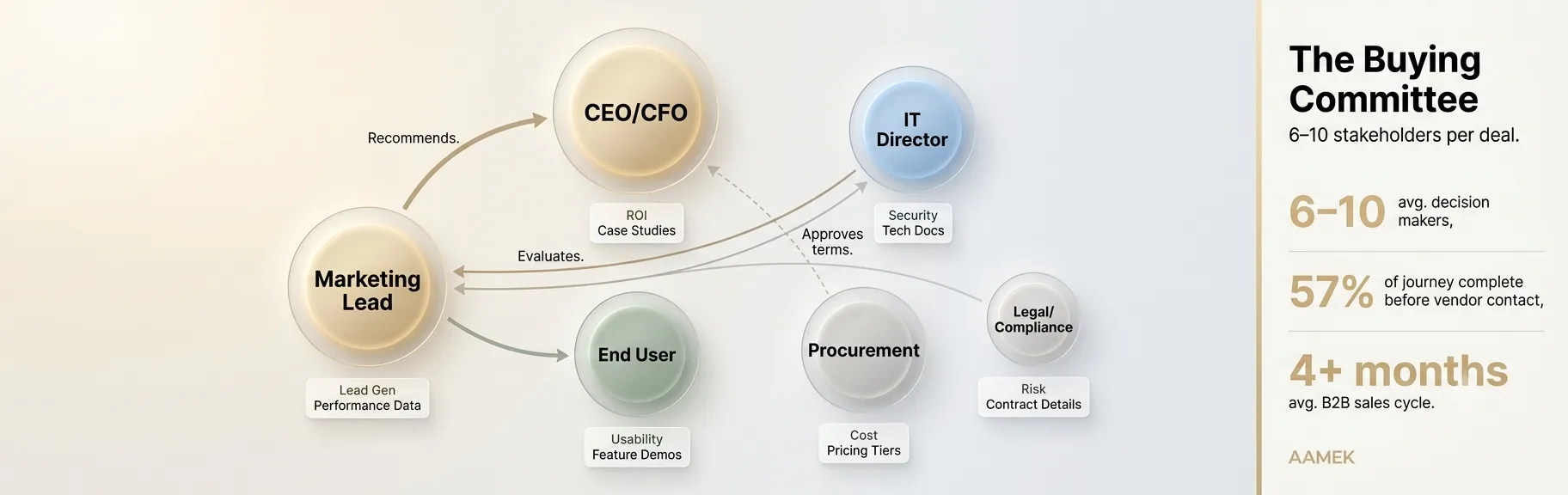
Step 3: Map the buying committee. In B2B, you are rarely selling to one person. A typical B2B purchase involves 6 to 10 decision-makers. Identify all stakeholders including champions, technical evaluators, financial approvers, and end users.
Step 4: Define pain points and buying triggers. What business problems drive your buyers to start researching solutions? What internal events – a leadership change, a compliance deadline, a growth target – trigger purchasing decisions?
Step 5: Document and distribute. Create formal persona documents and share them across marketing, sales, and customer success so all teams align around the same buyer understanding.
B2B Persona Comparison Table
| PERSONA TYPE | ROLE EXAMPLES | PRIMARY CONCERNS | CONTENT PREFERENCES |
|---|---|---|---|
| Executive Buyer | CEO, CFO, COO | ROI, business risk, competitive advantage | Executive summaries, case studies, strategic reports |
| Technical Evaluator | IT Director, CTO, Developer | Integration, security, scalability | Technical docs, product demos, API references |
| End User | Marketing Manager, Sales Rep | Ease of use, time savings, productivity | How-to guides, tutorials, short videos |
| Procurement | Purchasing Manager | Price, contracts, compliance | Vendor comparisons, pricing guides, legal terms |
B2B Content Strategy: Mapping Content to the Buyer Journey
Content is the fuel of every B2B inbound marketing strategy. Without a deliberate content plan that maps assets to specific funnel stages, you will create a lot of content with minimal business impact.
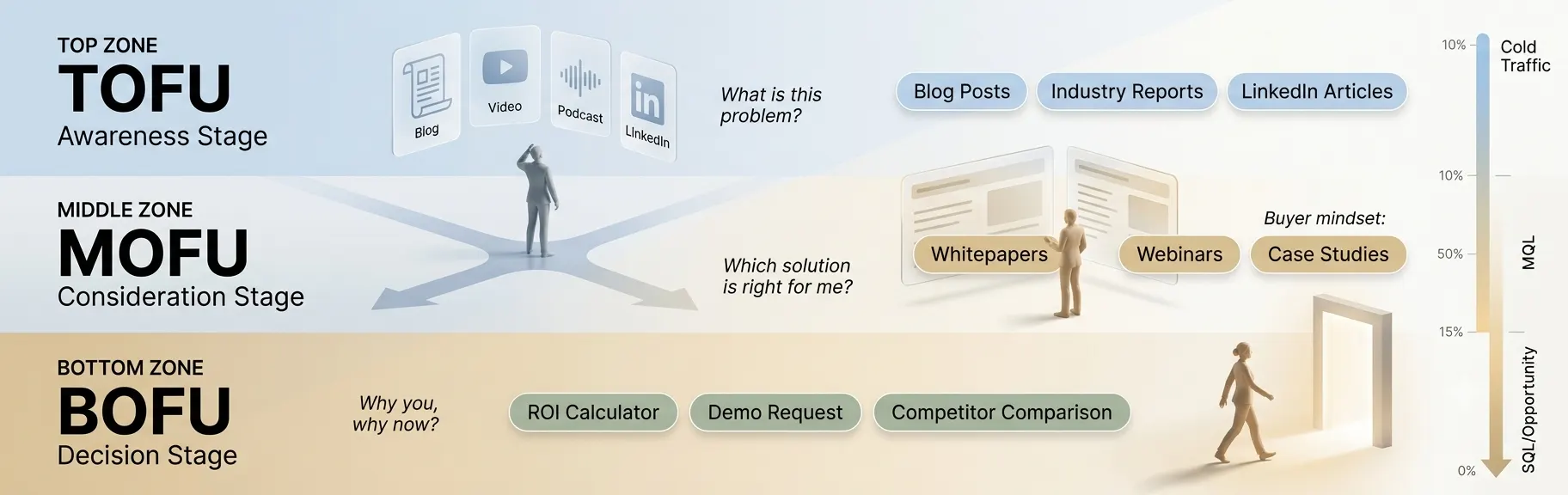
Top-of-Funnel (TOFU) Content: Awareness Stage
TOFU content addresses broad educational questions that buyers ask early in their research. Examples include:
- “What is demand generation?”
- “How do B2B companies generate leads?”
- “Best practices for sales and marketing alignment”
Best formats: Long-form blog posts, LinkedIn articles, podcast episodes, educational videos, industry reports
Middle-of-Funnel (MOFU) Content: Consideration Stage
MOFU content helps buyers evaluate approaches and compare solutions. Examples include:
- “Inbound vs. outbound marketing: which is better for B2B?”
- “How to build a B2B content marketing strategy”
- “B2B lead generation benchmarks by industry”
Best formats: Whitepapers, webinars, comparison guides, email courses, detailed case studies
Bottom-of-Funnel (BOFU) Content: Decision Stage
BOFU content directly supports the purchase decision. Examples include:
- “[Company name] vs. [Competitor]: a detailed comparison”
- “ROI calculator: what inbound marketing delivers for mid-market B2B companies”
- “Client success story: how [Company] generated 300% more qualified leads”
Best formats: Case studies, ROI calculators, product demos, free trials, consultation landing pages
SEO and Organic Search for B2B Pipelines
Organic search is the highest-leverage acquisition channel in a mature B2B inbound marketing strategy. It delivers compounding returns over time, attracts buyers at the exact moment of need, and builds brand authority with every published piece.
Topic Cluster Architecture
Rather than publishing isolated blog posts, modern B2B SEO uses topic clusters:
- Pillar Page: A comprehensive, authoritative guide on a broad topic (e.g., “The Complete Guide to B2B Lead Generation”)
- Cluster Content: Supporting articles targeting long-tail subtopics (e.g., “How to Use LinkedIn for B2B Lead Generation,” “B2B Lead Generation Metrics to Track”)
- Internal Linking: Every cluster article links back to the pillar page and to other cluster articles, concentrating topical authority
This architecture signals to Google that your site has deep expertise in a given subject area, improving rankings across all related terms.
Lead Nurturing and Marketing Automation
Generating leads is only half the battle. The real competitive advantage in B2B inbound marketing comes from how effectively you nurture those leads through a structured, automated workflow.
Building Effective B2B Nurture Sequences
A well-designed nurture sequence does three things simultaneously:
- Educates the lead on the problem, the solutions available, and why your approach is superior
- Builds trust through consistency, expertise, and value delivery without asking for anything
- Qualifies the lead by tracking which content they engage with, flagging high-intent behavior for sales follow-up
Email Nurture Sequence Blueprint
| EMAIL # | TIMING | OBJECTIVE | CONTENT TYPE |
|---|---|---|---|
| 1 | Immediately | Deliver lead magnet, welcome | Resource delivery + brand intro |
| 2 | Day 3 | Educate on core problem | Blog post or explainer |
| 3 | Day 7 | Introduce your approach | Methodology overview |
| 4 | Day 14 | Build proof | Case study or testimonial |
| 5 | Day 21 | Overcome objections | FAQ or comparison content |
| 6 | Day 28 | Soft CTA | Consultation or demo invite |
Lead Scoring in B2B Inbound
Lead scoring assigns numerical values to prospect behaviors and attributes:
- Demographic fit: Job title, company size, industry (+10 to +30 points)
- Behavioral signals: Page visits, email opens, content downloads (+5 to +25 points)
- High-intent actions: Pricing page visit, demo request, case study download (+50 points)
- Disqualifying factors: Competitor domain, student email, wrong geography (-20 points)
When a lead crosses a defined threshold – typically 100 points – they automatically route to a sales development representative for outreach.
Conversion Rate Optimization for B2B Inbound
Driving traffic is expensive. Converting more of the traffic you already have is almost always the highest-ROI lever available to B2B marketers. Systematic conversion rate optimization (CRO) is therefore a critical pillar of any B2B inbound marketing strategy.
High-Impact CRO Areas for B2B
Landing Pages:
- Test headline messaging: pain-point led vs. outcome-led copy
- Reduce form fields to the minimum required (name, email, company, role)
- Add social proof directly above the fold: logos, testimonials, specific metrics
- Use directional cues (arrows, imagery) pointing toward the primary CTA
CTAs Throughout Blog Content:
- Embed contextual CTAs within the body of long-form posts – not just at the bottom
- Use content-upgrade CTAs: offer a downloadable checklist that complements the specific post
- Test button copy: “Get the guide” typically outperforms “Submit” significantly
Homepage and Service Pages:
- Ensure the value proposition is clear within three seconds of landing
- Include a specific, low-friction primary CTA visible without scrolling
- Use customer logos and case study snippets to establish instant credibility
Measuring B2B Inbound Marketing Performance
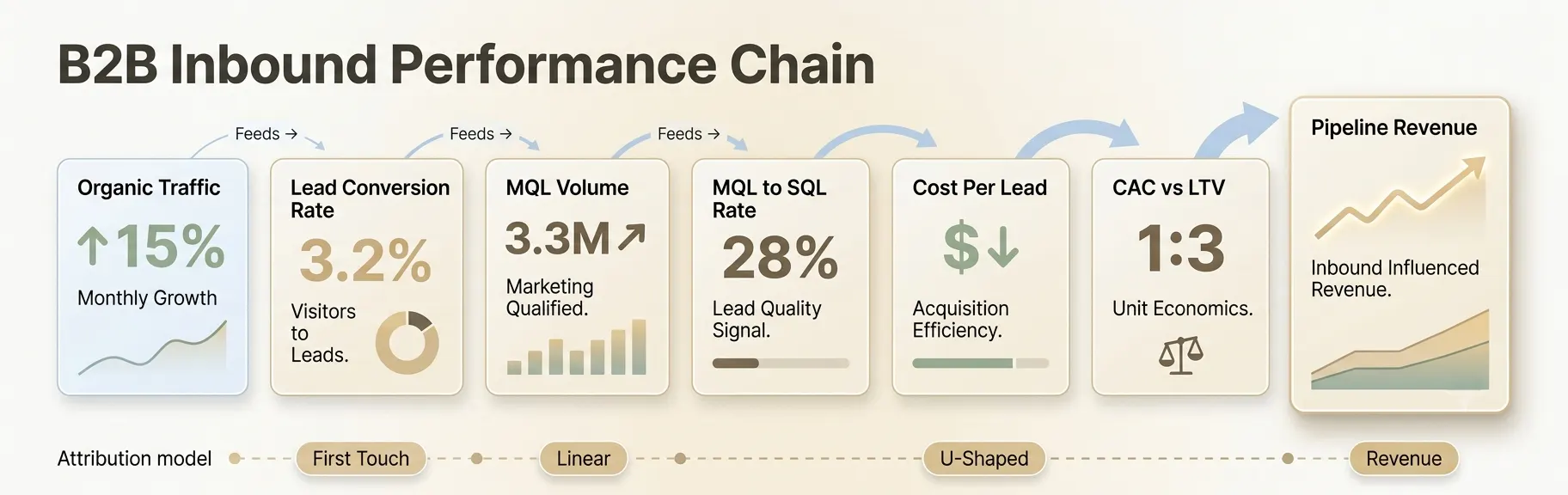
What you measure determines what you improve. A rigorous B2B inbound marketing strategy requires a defined measurement framework that connects marketing activity to revenue outcomes.
Core B2B Inbound KPIs
| METRIC | WHAT IT MEASURES | TARGET BENCHMARK |
|---|---|---|
| Organic Traffic Growth | SEO channel health | 10-20% MoM growth (early stage) |
| Lead Conversion Rate | Website efficiency | 2-5% for B2B landing pages |
| MQL to SQL Rate | Lead quality | 20-40% |
| Lead-to-Customer Rate | Full funnel efficiency | 1-5% depending on ACV |
| Cost Per Lead (CPL) | Acquisition efficiency | Varies by industry |
| Customer Acquisition Cost (CAC) | Overall efficiency | Less than 1/3 of LTV |
| Content ROI | Content program value | Track leads and revenue influenced |
Attribution Modeling
B2B attribution is complex because buyers interact with multiple touchpoints before converting. Consider these models:
- First-touch attribution: Credits the channel that first attracted the buyer
- Last-touch attribution: Credits the channel that drove the final conversion
- Multi-touch/linear attribution: Distributes credit across all touchpoints equally
- U-shaped attribution: Weights the first and last touchpoints most heavily (40%/40%/20%)
For most B2B companies, a U-shaped or custom multi-touch model provides the most accurate picture of which inbound channels drive pipeline.
Common Mistakes in B2B Inbound Marketing
Even experienced marketing teams make preventable errors that undermine their inbound program. Avoiding these mistakes can dramatically accelerate your results.
Mistake 1: Creating Content Without a Distribution Strategy
The most common B2B inbound failure is publishing content and waiting for traffic. Content distribution – through LinkedIn, email newsletters, syndication, and outreach – is equally important as creation.
Mistake 2: Ignoring the Full Buying Committee
Most B2B content strategies focus on one persona: the direct user. In reality, you need content that addresses the concerns of every stakeholder involved in the decision, from the technical evaluator to the CFO.
Mistake 3: Misaligning Sales and Marketing
Inbound generates leads; sales converts them. Without a formal SLA (service level agreement) between marketing and sales defining lead handoff criteria, follow-up timelines, and feedback loops, leads will fall through the cracks.
Mistake 4: Treating Inbound as a Short-Term Campaign
Inbound marketing is a long-term compounding investment. Many companies abandon their strategy after three to six months because they expect results similar to paid ads. Organic channels typically require six to twelve months before delivering consistent pipeline.
Mistake 5: Neglecting Bottom-of-Funnel Content
Many B2B content programs over-invest in awareness content and under-invest in BOFU assets that directly support the sales process. Case studies, ROI calculators, and competitive comparisons are often the highest-converting content on a B2B website.
Mistake 6: Failing to Measure Pipeline Contribution
Tracking pageviews and form submissions is insufficient. Every inbound investment should be traceable to pipeline created and revenue influenced. If you cannot connect your content program to revenue, you cannot justify the investment or optimize it intelligently.
Expert Tips to Accelerate Your B2B Inbound Results
These strategies give experienced practitioners a meaningful edge:
Tip 1: Use Intent Data to Prioritize Outreach Layer third-party intent data (from tools like Bombora or G2) on top of your inbound signals. When a target account is actively researching your category AND has engaged with your content, the timing for outreach is ideal.
Tip 2: Build Subject-Matter Expert (SME) Brands on LinkedIn Google’s E-E-A-T guidelines reward content created by demonstrable experts. Feature your team members as by-lined authors, build their LinkedIn audiences, and link their profiles to published content. This builds both search authority and social trust simultaneously.
Tip 3: Repurpose Long-Form Content Systematically A single 3,000-word pillar post can yield: 5 LinkedIn posts, 1 short-form video script, 1 email newsletter edition, 1 SlideShare deck, and 3 Twitter/X threads. Systematic repurposing maximizes the ROI of every content asset you produce.
Tip 4: Use Conversational ABM to Complement Inbound Account-based marketing (ABM) and inbound are not opposites. Use inbound to attract and warm up target accounts, then apply ABM tactics – personalized outreach, customized landing pages, tailored proposals – to accelerate conversion within those accounts.
Tip 5: Optimize for Google AI Overviews With Google’s Search Generative Experience expanding, structured content – clear definitions, numbered lists, comparison tables, and concise FAQ answers – increasingly earns featured placements in AI-generated overviews. Write content that directly answers questions rather than dancing around them.
Frequently Asked Questions: B2B Inbound Marketing Strategy
What is a B2B inbound marketing strategy?
A B2B inbound marketing strategy is a systematic methodology for attracting, engaging, and converting business buyers through valuable content, SEO, and permission-based marketing rather than interruptive outbound tactics. It aligns brand content and digital touchpoints with the buyer’s self-directed research journey across awareness, consideration, and decision stages.
How is B2B inbound marketing different from B2C inbound marketing?
B2B inbound marketing involves longer sales cycles, committee-based purchasing decisions, higher deal values, and content that must address multiple stakeholder personas simultaneously. B2C inbound typically targets individual consumers with shorter decision timelines and emotionally-driven content strategies.
How long does it take for a B2B inbound marketing strategy to show results?
Most B2B inbound programs take six to twelve months to generate consistent, measurable pipeline from organic channels. Initial results – traffic growth, early lead capture – often appear within three to four months. The full compounding effect of a mature inbound program typically materializes in year two and beyond.
What are the most important components of a B2B inbound marketing strategy?
The core components include: SEO and content strategy, buyer persona development, lead capture and landing page optimization, marketing automation and email nurture, CRM integration, sales and marketing alignment, and ongoing performance measurement.
What content types work best for B2B inbound marketing?
The most effective B2B inbound content formats are: long-form SEO blog posts, original research reports, gated whitepapers, case studies, ROI calculators, webinars, and comparison guides. Bottom-of-funnel content – particularly case studies and ROI tools – typically delivers the highest conversion rates.
How do you measure the ROI of a B2B inbound marketing strategy?
Measure ROI by tracking pipeline-influenced revenue, MQL and SQL volume, lead-to-customer conversion rates, and customer acquisition cost (CAC) relative to customer lifetime value (LTV). Multi-touch attribution modeling provides the most accurate picture of which inbound channels and content assets drive the most revenue.
Can small B2B companies implement an inbound marketing strategy effectively?
Yes. Smaller B2B companies often have a significant advantage in inbound because they can move faster, speak more authentically to a specific niche, and build genuine subject-matter expert authority in a defined category. Focused niche SEO and consistent thought leadership frequently outperform large-budget broad campaigns for SMBs.

Build a B2B Inbound Marketing Strategy That Compounds
A well-executed B2B inbound marketing strategy is not a single campaign or a collection of blog posts. It is a living, integrated system that continuously attracts high-intent buyers, nurtures them with precise, relevant content, and converts them into loyal customers who generate referrals and expansion revenue.
The companies that invest systematically in inbound infrastructure today – content, SEO, automation, and CRO – build a durable competitive advantage that accelerates over time. Meanwhile, those still relying exclusively on paid acquisition find themselves on a treadmill: the moment the spend stops, the leads stop.
The framework in this guide gives you everything you need to start building that compounding engine. From persona development and topic cluster SEO to lead scoring and attribution modeling, every element works together toward one outcome: a predictable, scalable B2B pipeline that your sales team can depend on.
Ready to stop guessing and start building a pipeline that grows on its own? Partner with AAMEK’s B2B marketing agency and get the strategic expertise, content systems, and demand-generation frameworks your business needs to compete at the highest level.
Pingback: B2B Content Strategy: Build Topical Authority Fast