
B2B lead generation is the structured process of identifying, attracting, and qualifying business buyers who match an ideal customer profile (ICP), then moving them through a defined pipeline toward a sales-ready stage. Modern B2B lead generation no longer treats inbound marketing and outbound prospecting as competing disciplines; it treats them as complementary systems that share data, messaging, and timing. Companies that integrate both approaches consistently report steadier pipeline coverage than those relying on a single channel.
If you have ever watched a quarter’s pipeline swing from feast to famine, you already know why this matters. Marketing teams pour budget into content and ads, sales teams cold-call and cold-email, and yet the two efforts rarely talk to each other. That disconnect is exactly what breaks B2B lead generation at scale, and it’s exactly what this guide fixes.
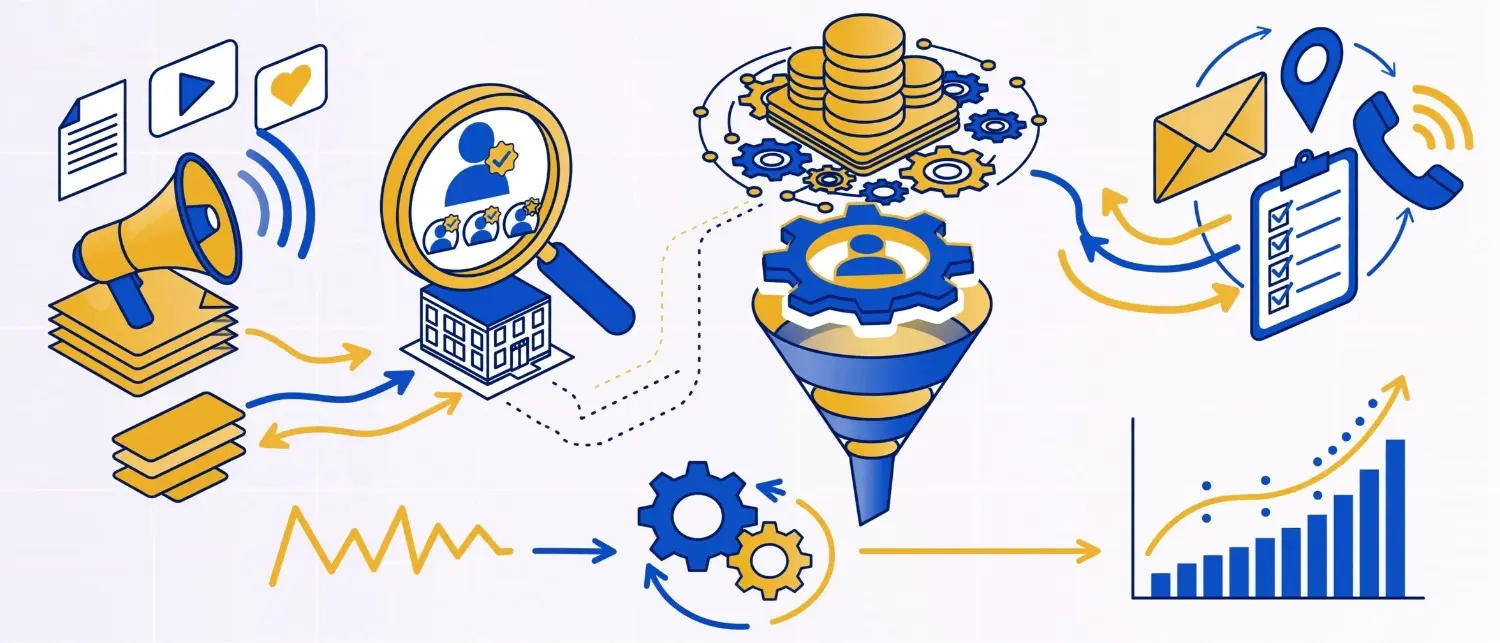
At AAMEK, we build integrated demand programs for B2B companies that need predictable, compounding pipeline rather than one-off traffic spikes. This article walks through why inbound alone isn’t enough, why outbound alone burns out, and how to combine both into a system that keeps generating qualified leads month after month.
What is B2B Lead Generation, Really?
Before diving into tactics, it helps to define the term precisely, since it gets used loosely across the industry.
B2B lead generation refers to the marketing and sales activities that identify potential business customers and capture enough information about them to begin a sales conversation. Unlike B2C lead generation, which often targets individual consumers on impulse or emotion,
B2B lead generation deals with:
- Longer sales cycles, often spanning weeks or months
- Multiple stakeholders and buying committees
- Higher average contract values
- A need for trust-building before commercial conversations begin
Consequently, B2B lead generation strategies must account for research-heavy buyers who compare vendors, read reviews, and consult peers before ever filling out a form, a pattern well documented in Gartner’s research on B2B buying journeys.

Inbound vs. Outbound: A Quick Definition
- Inbound lead generation attracts prospects through content, SEO, social proof, and organic discovery. The buyer initiates contact.
- Outbound lead generation proactively reaches prospects through cold email, cold calling, LinkedIn outreach, and targeted advertising. The seller initiates contact.
Neither approach is inherently superior; each solves a different problem in the pipeline.
Why Relying on One Channel Breaks B2B Lead Generation
Many founders and marketing leaders pick a lane early: either they invest heavily in inbound marketing and wait for organic traffic to convert, or they hire an SDR team and go all-in on cold outreach. Both paths have a ceiling.
The Inbound-Only Trap
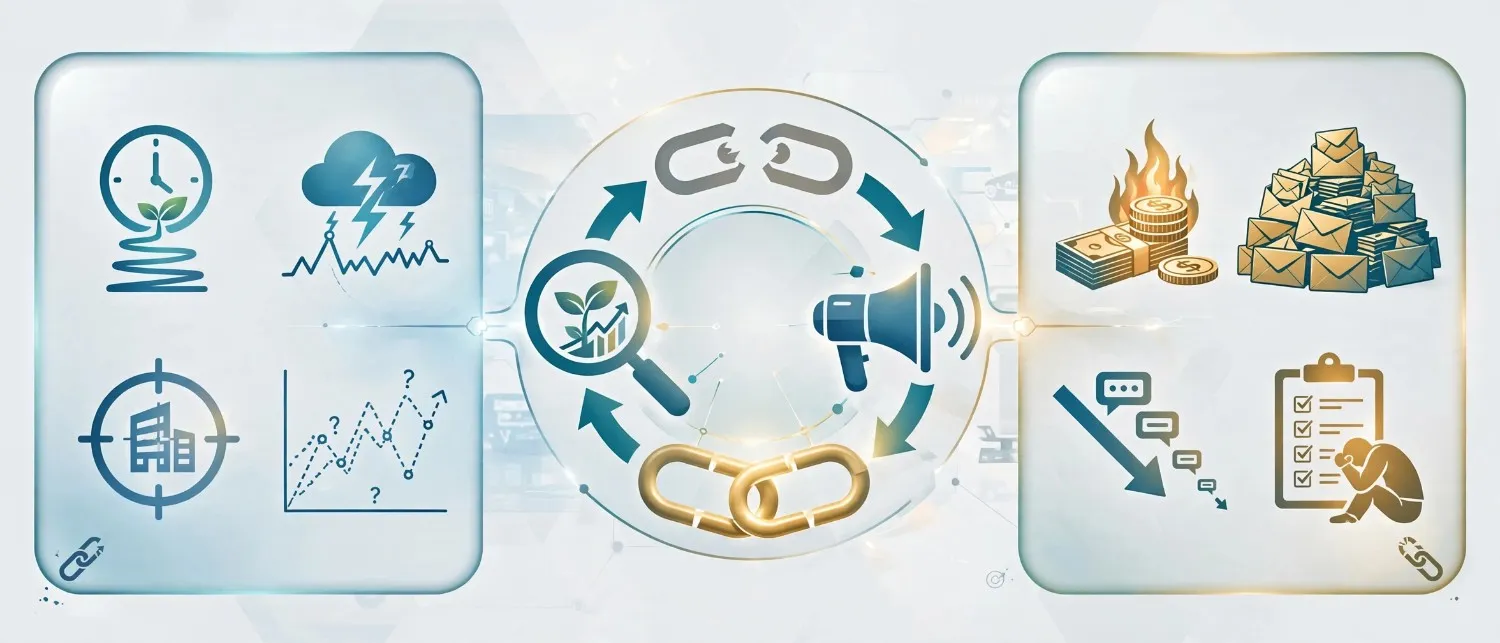
Inbound is durable, but slow to compound. A company that depends solely on SEO and content will experience:
- Long ramp-up periods before traffic materializes
- Vulnerability to algorithm updates and search volatility
- Difficulty targeting specific accounts or verticals precisely
- Lead volume that’s hard to forecast in the short term
The Outbound-Only Trap
Outbound generates faster short-term results, however, it also comes with its own constraints:
- Rising costs as inboxes get saturated with cold email
- Diminishing reply rates without warm signals to reference
- Heavy dependence on list quality and personalization at scale
- Burnout risk for SDR teams chasing volume targets
Because each channel has a different failure mode, the smartest B2B lead generation programs are the ones where inbound and outbound reinforce each other rather than compete for budget.
The Integrated Model: How Inbound and Outbound Work Together
The strongest B2B lead generation systems treat inbound as the signal generator and outbound as the accelerator. Here’s the practical logic behind that pairing.

1. Inbound Builds the Trust Layer
Content, SEO, and thought leadership establish credibility before a prospect ever hears from a salesperson. When outbound reps reach out to someone who has already read a blog post or seen a LinkedIn article from your brand, the reply rate improves measurably because the prospect recognizes the name, a dynamic HubSpot’s research on buyer trust also supports.
2. Outbound Targets the Accounts Inbound Can’t Reach
Not every ideal buyer is actively searching. Outbound lets teams go directly after named accounts that match the ICP, regardless of whether those accounts are currently in-market. This is where account-based marketing becomes especially valuable, since it aligns outbound targeting with the same firmographic criteria used in inbound content strategy.
3. Shared Intent Data Powers Both Channels
When marketing and sales share the same intent signals – content downloads, page visits, email opens – both channels can prioritize the same warm accounts instead of working in silos.
4. Retargeting Bridges the Gap
Prospects who engage with outbound emails but don’t convert can be retargeted with inbound content through paid social or display ads, keeping the brand visible during a longer evaluation window.
Step-by-Step: Building a Combined B2B Lead Generation Engine
Here is a practical sequence for building this system from scratch or restructuring an existing one.
Step 1: Define the Ideal Customer Profile (ICP).
Document firmographics, technographics, and buying triggers so both inbound content and outbound targeting pull from the same definition.
Step 2: Map the buyer journey stages.
Identify what a prospect needs to see, read, or hear at awareness, consideration, and decision stages.
Step 3: Build inbound assets around high-intent keywords.
Prioritize content that answers questions your ICP is actively searching, following the same demand generation logic used for full-funnel campaigns.
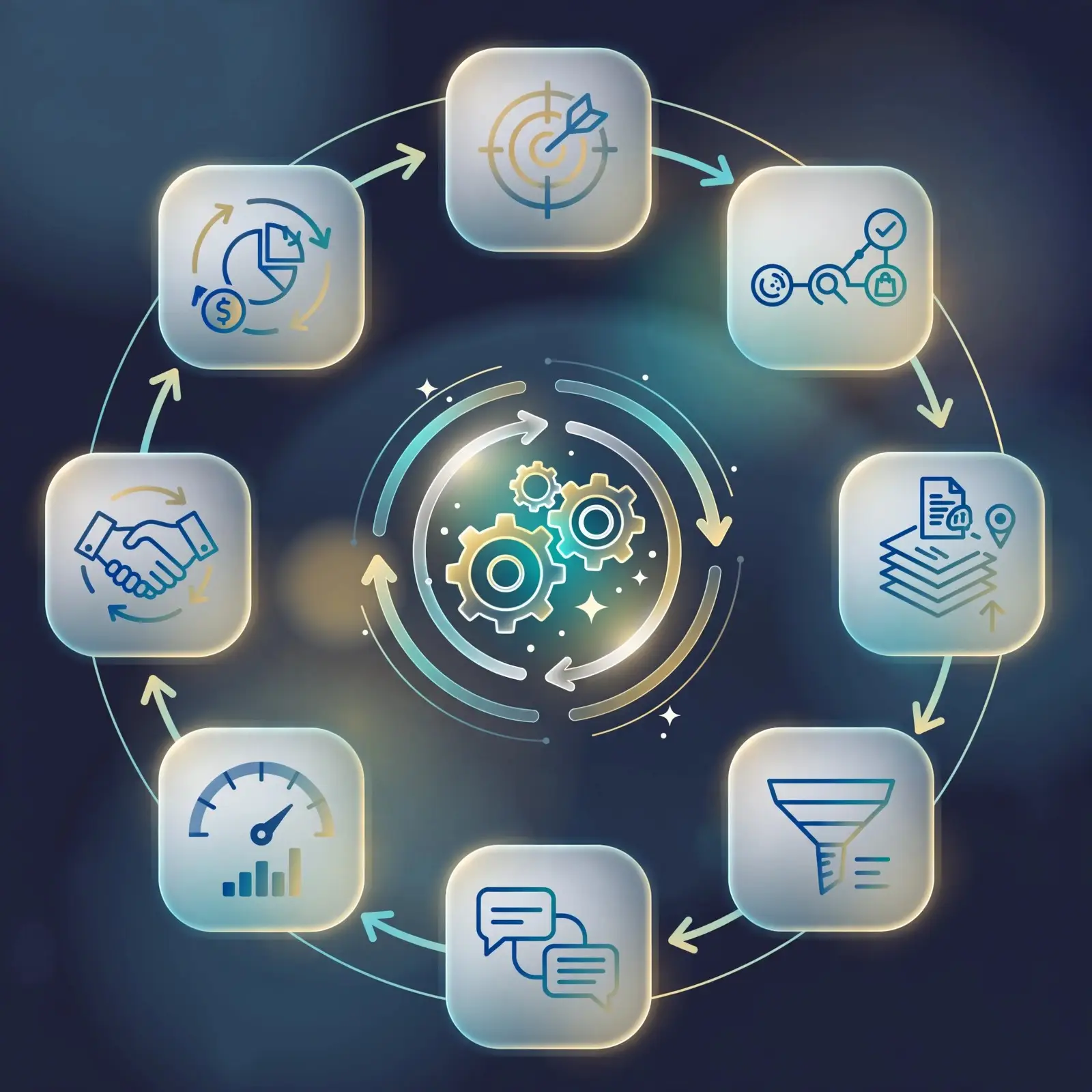
Step 4: Segment outbound lists by ICP fit and signal strength.
Prioritize accounts showing engagement with inbound content first.
Step 5: Align messaging across channels.
Outbound emails should reference the same pain points and value propositions used in top-performing inbound content.
Step 6: Set up lead scoring.
Combine behavioral data (inbound engagement) with firmographic fit (outbound targeting criteria) into one score.
Step 7: Establish a clear SLA between marketing and sales.
Define response times and follow-up cadences for leads generated through either channel.
Step 8: Review and iterate monthly.
Track which channel combinations produce the highest conversion-to-opportunity rate, then reallocate budget accordingly.
Common Mistakes That Undermine B2B Lead Generation
Even well-funded teams make avoidable errors when trying to scale lead generation. Watch for these patterns:
- Treating marketing and sales as separate departments with separate goals, rather than one revenue team with shared KPIs.
- Sending generic outbound emails that ignore inbound engagement history, missing an easy personalization opportunity.
- Publishing content without a clear next step, so inbound traffic never converts into a tracked lead.
- Ignoring lead scoring, which causes sales teams to waste time on low-fit leads while high-intent prospects go untouched.
- Measuring vanity metrics like blog traffic or email opens instead of pipeline-influenced revenue, a shift Google itself encourages under its guidance on people-first content.
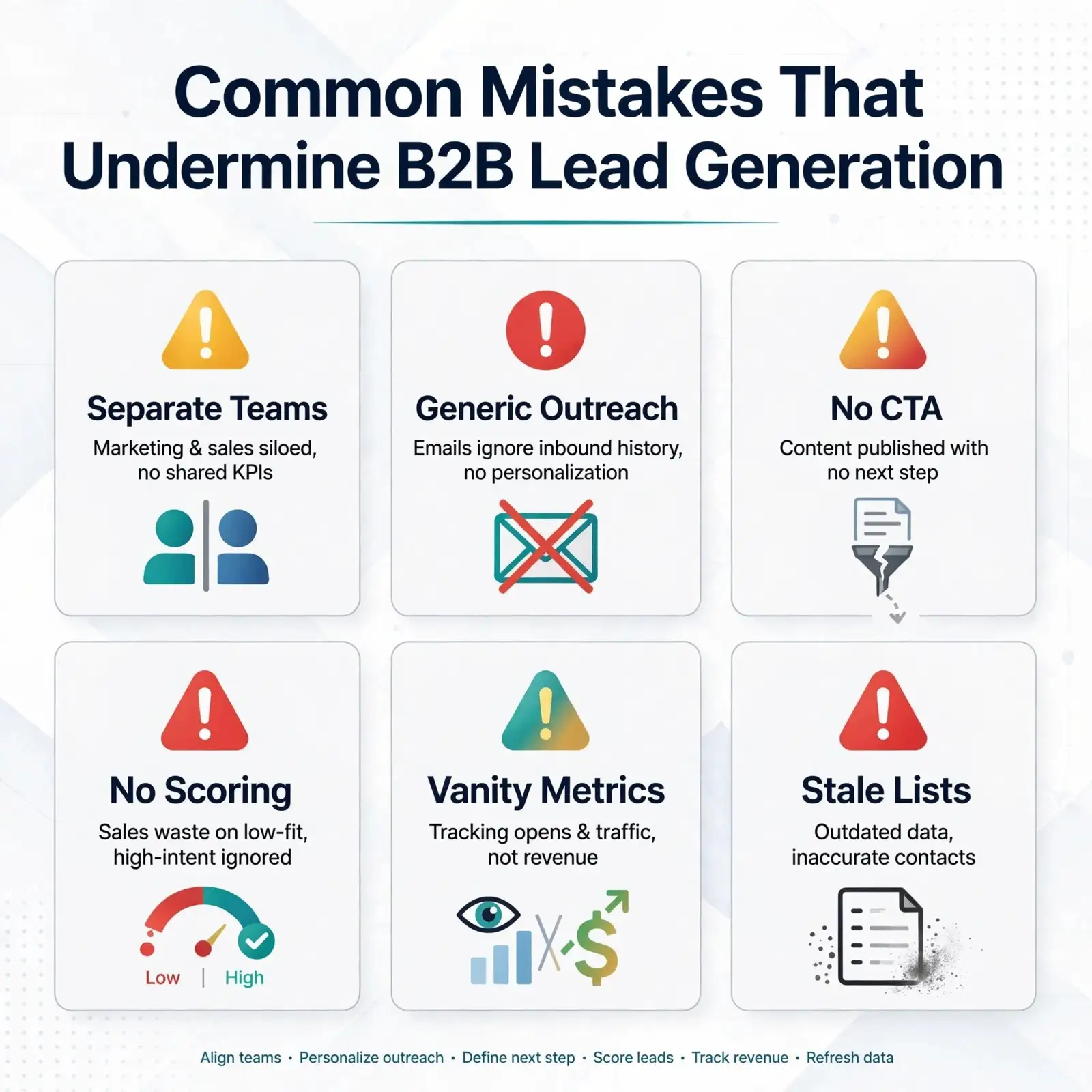
- Failing to refresh outbound lists, leading to outreach against stale or inaccurate data.
Avoiding these mistakes alone can meaningfully improve the output of an existing lead generation program, even before adding new tactics.
Expert Tips for Sustainable Pipeline Growth
- Prioritize account-based signals over generic firmographics. A smaller list of well-matched accounts consistently outperforms a broad, loosely targeted one.
- Use inbound content as outbound conversation starters. Reference a recent guide or webinar in the first line of a cold email instead of leading with a pitch.
- Keep sales and marketing in the same weekly meeting. Misalignment usually starts as a communication gap before it becomes a strategy gap.
- Test message-market fit before scaling volume. A small, high-response outbound sequence is more valuable than a large, low-response one.
- Document what “sales qualified” actually means. Ambiguity here is one of the most common causes of wasted lead generation spend.
Inbound vs. Outbound: Side-by-Side Comparison
| Factor | Inbound Lead Generation | Outbound Lead Generation |
|---|---|---|
| Initiation | Prospect-initiated | Seller-initiated |
| Time to results | Slower, compounding | Faster, short-term |
| Cost structure | Higher upfront, lower long-term | Lower upfront, ongoing per-lead cost |
| Targeting precision | Broad, keyword-driven | Narrow, account-specific |
| Trust-building | Strong, content-led | Requires personalization to build trust |
| Scalability | Compounds over time with SEO equity | Scales with headcount or tooling |
| Best used for | Category education, brand authority | Named account penetration, quota coverage |
Sample Channel Mix by Company Stage
| Company Stage | Recommended Inbound Focus | Recommended Outbound Focus |
|---|---|---|
| Early-stage / pre-PMF | Foundational SEO content, category education | Light outbound to validate messaging |
| Growth stage | Scaled content + paid social retargeting | Structured SDR outreach to named accounts |
| Enterprise / mature | Thought leadership, gated research reports | ABM programs targeting strategic accounts |
Frequently Asked Questions
What is the difference between B2B lead generation and demand generation?
B2B lead generation focuses specifically on capturing contact information and moving prospects into a sales pipeline, while demand generation is the broader strategy of building awareness and interest across the entire funnel, of which lead generation is one part.
Is inbound or outbound better for B2B lead generation?
Neither is universally better. Inbound tends to produce higher-trust, slower-building pipeline, while outbound produces faster but more resource-intensive results. Most sustainable B2B lead generation programs use both together.
How long does it take to see results from B2B lead generation?
Outbound campaigns can produce initial replies within days, while inbound-driven B2B lead generation, particularly through SEO, typically takes three to six months to gain meaningful traction.
What is a good conversion rate for B2B lead generation?
Conversion benchmarks vary by industry, but a healthy range for marketing-qualified lead (MQL) to sales-qualified lead (SQL) conversion is typically between 10-20%, with wide variation based on ICP fit and lead scoring maturity.
How does account-based marketing fit into B2B lead generation?
Account-based marketing narrows B2B lead generation efforts to a defined list of high-value target accounts, aligning inbound content and outbound outreach around the same accounts to increase relevance and conversion rates.
Should sales and marketing teams share the same lead generation metrics?
Yes. Shared metrics, such as pipeline generated and conversion-to-opportunity rate, keep both teams focused on revenue outcomes rather than siloed activity metrics like content views or call volume.
Conclusion
B2B lead generation stops being unpredictable the moment inbound and outbound stop operating as separate strategies. Inbound builds the trust and content foundation that makes outreach land better, while outbound reaches the accounts that inbound alone would never surface. Together, they create a pipeline that doesn’t rely on a single channel’s performance in any given month.

If your team is ready to build a B2B lead generation system that blends both approaches into one predictable pipeline engine, built around your ICP and revenue goals.