
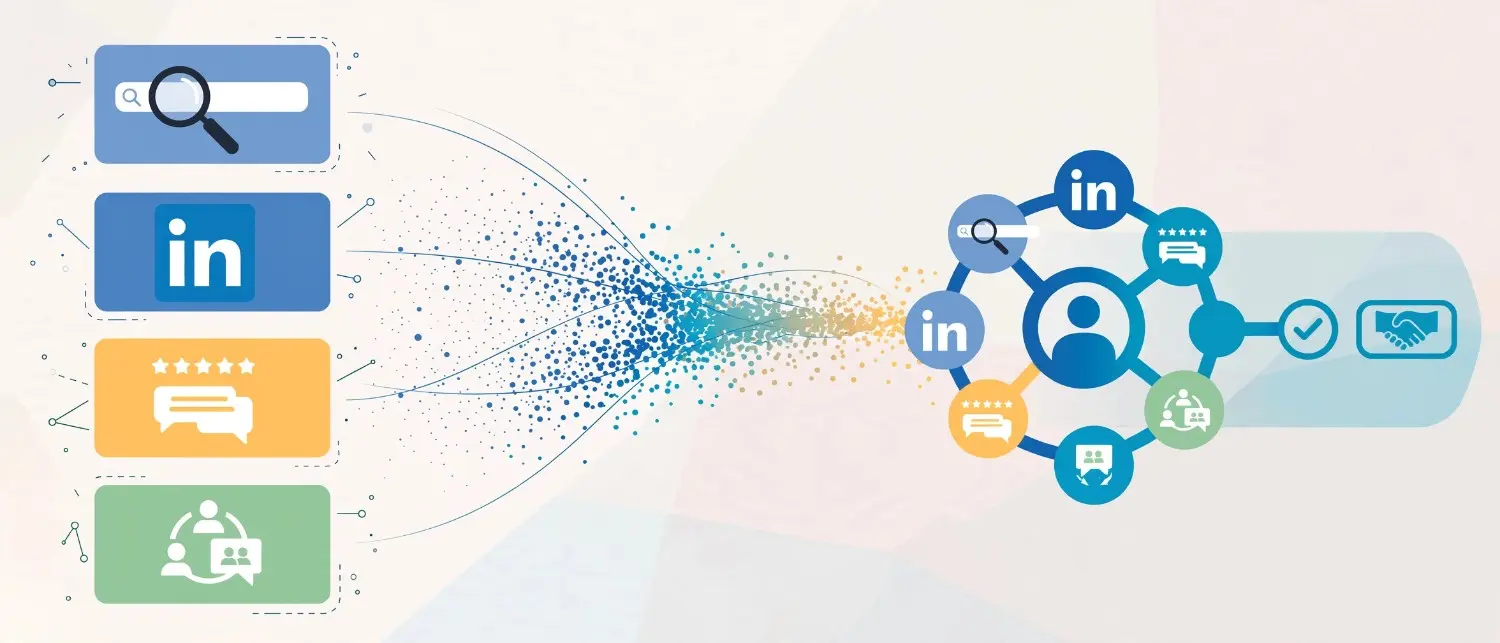
A B2B digital marketing strategy built on channel integration unifies paid, organic, email, and account-based efforts into a single, data-connected system rather than a set of disconnected campaigns. Instead of each channel chasing its own metrics in isolation, integration aligns SEO, paid media, content, and sales enablement around one shared pipeline goal. The result is a buyer journey that feels seamless to the prospect, even though it spans a dozen touchpoints and multiple teams behind the scenes.
Most B2B marketing teams already run the individual channels well. LinkedIn ads perform. The blog ranks. Email nurtures convert at a decent clip. Yet pipeline still feels unpredictable, and attribution reports rarely agree with what sales actually experiences in the field. That gap is almost always a channel integration problem, not a channel performance problem, and closing it is exactly what a dedicated B2B marketing agency’s multichannel execution framework is built to solve.
This guide breaks down what channel integration actually means for B2B organizations, why fragmented execution is quietly capping growth, and how to build a connected, measurable system step by step.
What is B2B Digital Marketing Strategy Channel Integration?
In simple terms, channel integration is the practice of designing every marketing channel to reinforce the others instead of operating as a standalone silo.
Quick answer: B2B digital marketing strategy channel integration means connecting SEO, paid media, email, social, and account-based programs through shared data, consistent messaging, and coordinated timing so that every channel contributes to one pipeline outcome instead of competing for isolated credit.

A genuinely integrated approach typically includes:
- A shared data layer that tracks the same accounts and contacts across every channel
- Messaging that stays consistent whether a buyer sees an ad, reads a blog post, or opens an email
- Campaign calendars that coordinate timing instead of each channel launching independently
- Attribution models that credit the full path to conversion, not just the last click
Why Channel Integration Matters for a B2B Digital Marketing Strategy
Buyer behavior has changed faster than most internal marketing structures have. Understanding why integration matters starts with understanding how B2B buyers actually research and decide.
Fragmented Buyer Journeys

Modern B2B buyers move between search engines, review sites, LinkedIn, peer communities, and vendor content long before they ever fill out a form. According to Gartner’s research on B2B buying behavior, buyers spend the majority of their purchase journey researching independently, often across six or more distinct channels before engaging a sales rep. If each of those channels tells a slightly different story, trust erodes quickly.
Rising CAC and Attribution Complexity

Customer acquisition costs across paid social and search have climbed steadily for years. When channels operate independently, teams tend to over-invest in whichever channel shows the best last-click numbers, even if that channel is simply capturing demand that another channel created. Integration corrects this by measuring influence across the full path.
The Shift Toward Account-Based Experiences

Account-based marketing has moved from a niche tactic to a mainstream expectation. Buying committees for enterprise and mid-market deals now include five to ten stakeholders on average, and each one needs a consistent, coordinated experience regardless of which channel introduces them to the brand. An account-based marketing framework only works when the channels feeding it are already talking to each other.
The Cost of Staying Siloed

Fragmentation rarely shows up as an obvious failure. It shows up as slow, compounding inefficiency: a paid social team bidding on branded terms that SEO already owns organically, an email nurture sequence that contradicts what a prospect just read in a sales deck, or a content calendar that has no idea a major paid campaign is launching the same week. None of these mistakes are fatal on their own. Together, they quietly inflate customer acquisition cost, slow deal velocity, and make every quarterly report a negotiation about whose channel deserves credit rather than a genuine read on what is working.
Leadership teams often respond to this by adding more reporting rather than fixing the underlying structure. More dashboards do not solve a coordination problem; they usually just document it in more detail. Real progress comes from redesigning how channels plan, launch, and measure together, which is exactly what the pillars below are built to address.
Core Pillars of an Integrated B2B Digital Marketing Strategy
A durable channel integration strategy rests on a few structural pillars. Skipping any one of them tends to create the same fragmentation the strategy is meant to fix.
Unified Data and Analytics

Every integrated strategy starts with a single source of truth. That usually means:
- One CRM record per account, updated by every channel
- A shared UTM and campaign naming convention across teams
- A multi-touch attribution model instead of first-touch or last-touch only
- Marketing automation platforms connected directly to the CRM, not run in parallel
Consistent Messaging Across Channels

Messaging consistency does not mean repeating the same sentence everywhere. It means the underlying value proposition, proof points, and positioning stay aligned whether the buyer encounters a LinkedIn ad, a nurture email, or a sales deck. A prospect who sees three different value propositions in one week has three reasons to distrust the fourth.
Coordinated Content and Demand Generation

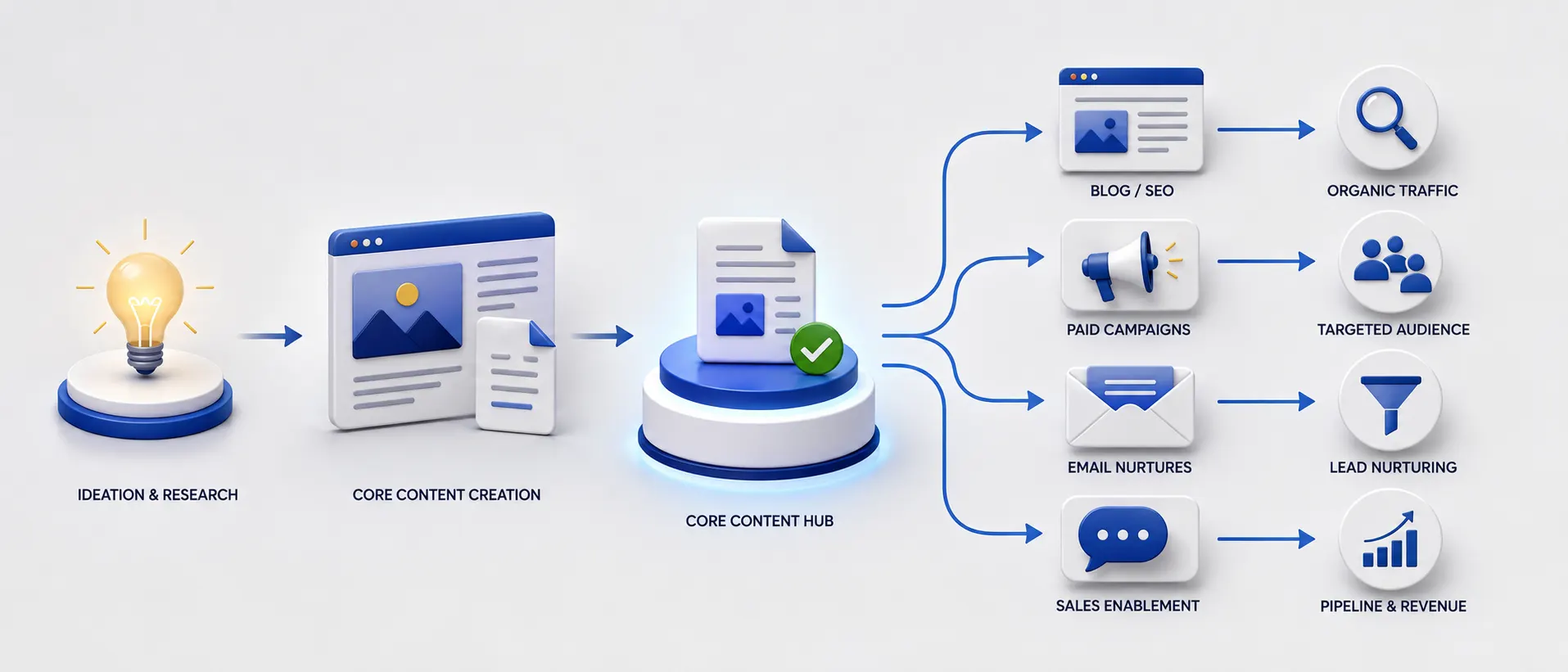
Content should not be produced in a vacuum and then distributed after the fact. In an integrated model, content briefs are built with SEO, paid, email, and sales enablement needs in mind simultaneously, so one core asset can fuel a webinar, a paid campaign, a nurture sequence, and an SDR talk track at the same time. This is the same logic behind a well-run demand generation framework that moves buyers from awareness to pipeline.
Cross-Functional Governance

Even a strong data foundation and consistent messaging will erode without a governance structure to maintain them. Most organizations that sustain integration long-term put a lightweight structure in place rather than a heavy committee:
- A single monthly cross-channel planning meeting where SEO, paid, email, and ABM owners align on upcoming launches
- A shared campaign brief template that every channel references before building assets
- A quarterly attribution review where finance, sales, and marketing agree on which metrics define success
- A documented escalation path for when channels disagree on messaging or targeting priorities
Without this kind of light governance, integration tends to hold for one or two campaigns and then quietly drift back into silos as teams revert to familiar habits under deadline pressure.
Channel-Specific Integration Tactics
Integration principles only matter once they translate into how each channel actually operates day to day. The tactics below show what changes in practice for each major channel once it becomes part of a connected B2B digital marketing strategy rather than an independent workstream.
SEO and Organic Content

SEO’s role in an integrated strategy expands beyond rankings. Content briefs should be built with paid retargeting audiences, email nurture topics, and sales objection-handling in mind from the outset. A single pillar page, for example, can simultaneously target a high-intent keyword, seed a retargeting audience for paid social, and supply the core argument for a three-part nurture sequence. Keyword research should also feed the ABM team, since the terms an account searches for often reveal exactly where they sit in the buying cycle.
Paid Search and Paid Social

Paid media performs best in an integrated model when it is used to accelerate proven organic and content performance rather than to test unproven messaging in isolation. Retargeting audiences should be built from actual content engagement and email activity, not just generic site visitors. Bidding strategy should also account for what SEO already ranks well for, redirecting paid budget toward gaps rather than duplicating spend on terms already won organically.
Email and Lifecycle Marketing

Email works as the connective tissue between every other channel because it is the one channel where messaging can be sequenced precisely around what a contact has already seen. Integrated email programs pull triggers from paid engagement, content downloads, and even sales activity, rather than relying solely on a static drip schedule. This keeps the buyer’s experience continuous instead of resetting every time they move between channels.
Account-Based Marketing and Sales Enablement

ABM is where integration becomes most visible to the buyer, since it depends entirely on every channel recognizing the same target account and responding in a coordinated way. A well-run program synchronizes paid ad targeting, personalized landing pages, and sales outreach so a buying committee member sees a consistent, increasingly specific experience as their account engagement deepens. Sales enablement content should be built directly from what marketing already knows converts, closing the loop between the two teams.
Organic Social

Organic social often gets treated as a distribution afterthought, but in an integrated strategy it plays a specific role: building familiarity and trust before a prospect ever clicks an ad or opens an email. Social content should echo the themes of current campaigns without duplicating the exact messaging, giving buyers a sense of consistency without repetition fatigue.
Channel Roles at a Glance
| Channel | Primary Role in Integration | Key Shared Data Point |
|---|---|---|
| SEO and Content | Builds top-of-funnel authority and fuels other channels | Ranking keywords, content topics |
| Paid Search and Social | Accelerates reach and retargets warm accounts | Account engagement scores |
| Email and Nurture | Sustains relationships between active touchpoints | Lifecycle stage, engagement history |
| ABM and Sales Enablement | Personalizes outreach for priority accounts | Target account list, intent signals |
| Organic Social | Builds trust and amplifies content reach | Engagement and share data |
Step-by-Step Guide to Building an Integrated B2B Digital Marketing Strategy
- Audit existing channels independently. Document what each channel is currently doing, who owns it, and what data it produces before attempting to connect anything.
- Map the actual buyer journey. Interview recent customers or review closed-won deals to understand which channels genuinely influenced the decision, not just which one gets last-click credit.
- Build a shared data foundation. Standardize UTM parameters, CRM fields, and lead scoring criteria so every channel reports into the same system.
- Create a unified messaging framework. Define the core value proposition, proof points, and objections once, then adapt tone per channel rather than rewriting the message from scratch.
- Align campaign calendars. Coordinate launch timing so paid, email, and content support each other instead of competing for the same audience attention in the same week.
- Implement multi-touch attribution. Move away from single-touch models so budget decisions reflect the full contribution of each channel.
- Review and reallocate quarterly. Use integrated reporting to shift budget toward the channel combinations that actually produce pipeline, not just volume.
Comparison: Siloed vs Integrated B2B Digital Marketing Strategy
| Factor | Siloed Approach | Integrated Approach |
|---|---|---|
| Data | Separate dashboards per channel | Single shared source of truth |
| Messaging | Varies by team and channel | Consistent core narrative |
| Attribution | First-touch or last-touch only | Multi-touch, full-funnel |
| Budget Decisions | Based on isolated channel ROI | Based on cross-channel influence |
| Buyer Experience | Disjointed and repetitive | Cohesive and progressive |
| Reporting Cadence | Channel-by-channel, ad hoc | Unified, recurring pipeline review |
Common Mistakes in B2B Channel Integration

- Treating integration as a tooling problem. Buying a new martech platform without aligning teams on process rarely fixes fragmentation. Software can support integration, but it cannot substitute for agreement on shared goals and definitions.
- Letting last-click attribution drive budget. This consistently underfunds top-of-funnel channels like SEO and content that create demand rather than capture it, starving the exact channels that make every other channel more efficient.
- Skipping sales alignment. If SDRs and account executives are not looped into campaign timing and messaging, the buyer experience breaks down at the exact moment it matters most, often right when a lead is handed off.
- Over-standardizing messaging. Forcing identical copy across every channel ignores how buyers actually consume content differently on LinkedIn versus email versus a landing page, which flattens the experience instead of strengthening it.
- Ignoring lifecycle stage. Sending the same message to a brand-new lead and a sales-qualified opportunity wastes both the channel and the account’s attention, and can actively slow a deal that was already progressing.
- Building integration around campaigns instead of accounts. Campaign-level integration coordinates timing well but often loses sight of the individual account’s journey, which matters far more in B2B than in transactional B2C marketing.
- Underestimating the change management effort. Integration usually requires teams to give up some autonomy over their channel, and skipping the internal buy-in conversation is one of the most common reasons integration efforts stall after a strong start.
Expert Tips for Sustainable Channel Integration

- Start with two or three channels and prove the integration model before expanding to the full stack; trying to integrate everything at once usually collapses under its own coordination overhead.
- Assign one owner for cross-channel reporting so accountability does not fall between teams, even if that person does not manage every channel directly.
- Revisit your ideal customer profile every two quarters; channel mix should shift as the ICP sharpens, since the channels that work for a broad audience rarely work as well for a narrowly defined one.
- Use intent data to decide which accounts move from broad-reach channels into account-based programs, rather than applying ABM uniformly to every account in the CRM.
- Pair every integrated campaign with a post-mortem that captures what worked across channels, not just within one, and feed those findings directly into the next quarter’s planning meeting.
- Protect a testing budget outside the core integrated plan; channel integration should not eliminate experimentation, it should just make experimentation easier to evaluate fairly.
- Keep the messaging framework in a single, easily accessible document; integration breaks down quickly when each team is working from a slightly different version of the value proposition.
Measuring Success: KPIs for an Integrated B2B Digital Marketing Strategy
| KPI | What It Reveals |
|---|---|
| Multi-touch pipeline influence | Which channel combinations actually move deals forward |
| Marketing-sourced and marketing-influenced pipeline | The full contribution of marketing, not just first or last touch |
| Account engagement score | Whether target accounts are engaging across multiple channels |
| Cost per opportunity (blended) | True efficiency across the integrated channel mix |
| Sales and marketing alignment score | Whether both teams agree on lead quality and readiness |
How AI and Automation Are Reshaping B2B Digital Marketing Strategy

AI-driven search experiences and generative answer engines are changing how buyers discover vendors, which makes channel integration more important, not less. Google’s own guidance on creating helpful, people-first content makes clear that pages built primarily to attract search traffic, rather than to genuinely help a reader, are increasingly penalized rather than rewarded. When a buyer’s first interaction with a brand might be an AI-generated summary rather than a search results page, consistent, well-structured, and genuinely useful content across every channel becomes the deciding factor in whether that summary represents the brand accurately. Marketing teams that already have unified messaging and data are far better positioned to adapt, because the underlying story does not need to be rebuilt for every new surface.
This is also why relying purely on organic keyword-driven traffic is becoming a weaker strategy on its own. Shifting core KPIs toward pipeline, revenue influence, and brand authority, rather than raw traffic, keeps an integrated strategy resilient as search behavior continues to evolve.
Automation is also changing what integration looks like operationally. Marketing teams increasingly use AI to draft first versions of ad copy, email variants, and landing page tests, but the strategic decisions about audience, timing, and message still need a human owner who understands how each channel fits into the broader account journey. Treating automation as a way to execute the integrated plan faster, rather than as a replacement for the plan itself, keeps AI adoption from accidentally reintroducing the fragmentation that integration was meant to solve, since disconnected AI tools operating without shared context can just as easily create five more disjointed channels as they can streamline five existing ones.
Budget Allocation for an Integrated B2B Digital Marketing Strategy

One of the most common questions once channels are integrated is how to split budget across them fairly. Rather than allocating by channel in isolation, integrated teams typically allocate by funnel stage first, then distribute within each stage based on multi-touch performance:
- Top-of-funnel (awareness): SEO, content, organic social, and broad-reach paid campaigns designed to build category awareness with the target audience.
- Mid-funnel (consideration): Retargeting, email nurture, webinars, and comparison content that help an engaged prospect evaluate the option seriously.
- Bottom-of-funnel (decision): ABM programs, sales enablement content, case studies, and highly targeted paid campaigns aimed at active buying committees.
This structure keeps budget conversations focused on funnel outcomes rather than channel loyalty, which tends to reduce the internal politics that often accompany annual budget planning.
A Practical Scenario
Consider a mid-market software company that historically ran SEO, paid search, and email as three separate workstreams, each reporting to a different stakeholder. Paid search consistently looked like the top-performing channel because it captured last-click credit on branded terms that SEO had already built awareness for. Once the team implemented multi-touch attribution and aligned campaign calendars, the picture changed substantially: SEO and content were shown to influence a majority of eventual paid conversions, and the team reallocated a meaningful share of paid budget toward content production and account-based retargeting. Pipeline did not just grow; it also became noticeably more predictable quarter over quarter, since the team could finally see which channel combinations, not single channels, were actually driving results.
Where Content Fits Into the Bigger Picture
Channel integration does not replace the need for a strong content engine; it depends on one. Teams that have not yet built a structured approach to content planning often find that integration efforts stall simply because there is not enough consistent material to feed every channel. Reviewing a full-funnel content strategy alongside your channel plan can help identify content gaps before they slow down execution. Similarly, teams still relying primarily on outbound tactics benefit from revisiting the fundamentals of an inbound marketing methodology, since inbound and integrated multichannel execution reinforce each other rather than competing for budget.
Frequently Asked Questions


What is the difference between multichannel and integrated B2B digital marketing strategy?
Multichannel simply means using several channels. An integrated B2B digital marketing strategy specifically connects those channels through shared data, consistent messaging, and coordinated timing so they reinforce one another.
How long does it take to integrate a B2B digital marketing strategy across channels?
Most organizations see meaningful alignment within one to two quarters, though full data and attribution integration can take longer depending on existing martech complexity.
Which channels should be integrated first in a B2B digital marketing strategy?
Start with the two channels generating the most pipeline today, typically SEO or paid search paired with email nurture, before expanding into ABM and social.
Does channel integration require new marketing technology?
Not necessarily. Many teams achieve integration by better connecting existing tools and standardizing data practices before purchasing anything new.
How do you measure ROI on an integrated B2B digital marketing strategy?
Use multi-touch attribution and blended cost-per-opportunity metrics rather than evaluating each channel’s ROI in isolation.
Who should own channel integration inside a B2B marketing team?
Ideally a single marketing operations or growth lead owns cross-channel reporting and governance, while individual channel owners retain execution control within the shared framework.
Can a small marketing team realistically integrate multiple channels?
Yes. Small teams often integrate faster than large ones because there are fewer stakeholders to align; the priority should be a shared data foundation and consistent messaging before adding more channels.
Conclusion

An integrated B2B digital marketing strategy is not about running more channels; it is about making the channels already in use work as one connected system instead of five separate ones. The organizations that get this right consistently outperform on pipeline predictability, not because they spend more, but because every channel is reinforcing the same story, the same data, and the same account priorities. Ready to move from fragmented campaigns to one connected pipeline engine? about building a channel integration strategy tailored to your buying committee.
Pingback: B2B SEO Strategy: From Keywords to Revenue