
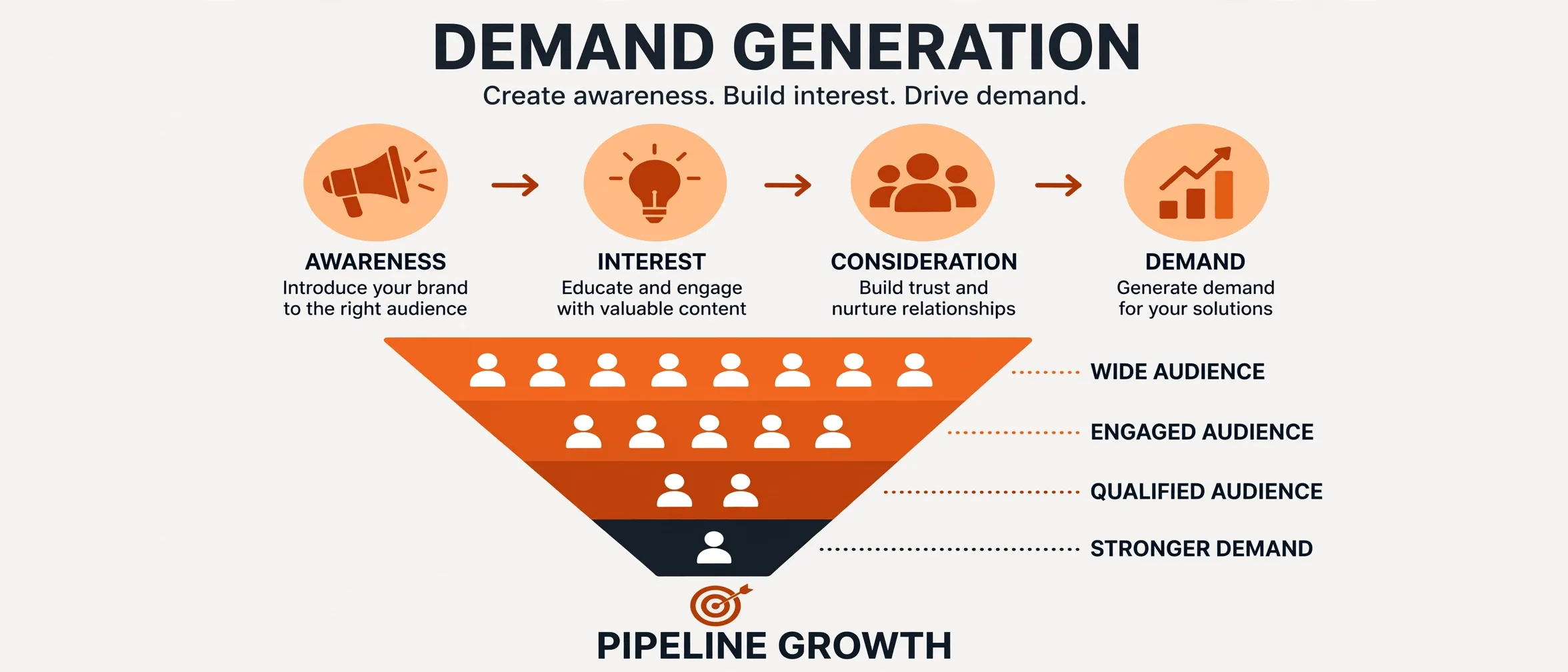
A B2B demand generation strategy is a full-funnel, revenue-focused framework that combines content marketing, multi-channel paid and organic distribution, account-based targeting, and intent-data activation to systematically convert anonymous market demand into qualified pipeline. Unlike lead generation, which focuses on capturing contact information, demand generation builds brand authority, educates buyer committees, and accelerates purchase intent across every stage of a complex buying cycle. Executed correctly, it produces compounding returns: lower cost-per-opportunity, shorter sales cycles, and predictable revenue growth.
Most B2B companies generate awareness. Far fewer convert that awareness into consistent, measurable pipeline. The gap between the two is strategy – and that is precisely what this guide addresses. Whether you are scaling a startup or optimizing an enterprise revenue engine, the frameworks, tactics, and frameworks below will help you close that gap systematically.
What is B2B Demand Generation and Why Does It Matter?
Demand generation is the disciplined practice of creating, capturing, and accelerating market interest in your product or service, ultimately translating that interest into sales-ready pipeline. It is not a single campaign or channel. It is an integrated operating system for revenue.
The Difference Between Demand Generation and Lead Generation
Marketers frequently use these two terms interchangeably, but they serve very different purposes:
| Dimension | Demand Generation | Lead Generation |
|---|---|---|
| Primary Goal | Create and capture market demand | Collect contact information |
| Funnel Stage | Full-funnel (awareness to close) | Mid-to-lower funnel |
| Content Type | Educational, thought leadership | Gated assets, demos |
| Success Metric | Pipeline value, revenue influenced | MQL volume, form fills |
| Buyer Experience | Self-directed discovery | Form-gated friction |
| Time Horizon | Long-term brand compounding | Short-term volume |
Understanding this distinction is critical. A strategy built only on lead generation produces volume without intent. A strategy built only on demand generation produces awareness without accountability. The most effective B2B revenue teams integrate both into a single, connected system.
Why Demand Generation Is a Strategic Imperative in 2025 and Beyond
According to research from Gartner, B2B buyers now spend only 17% of their total buying journey meeting with potential suppliers. The rest of that time is spent on independent research, internal consensus-building, and evaluation. By the time a prospect reaches your sales team, they have already formed strong preferences.
This reality means your demand generation strategy must work overtime to:
- Build brand awareness before buyers enter an active buying cycle.
- Establish your authority during independent research phases.
- Nurture preference through remarketing, content, and community.
- Create urgency and pipeline velocity when intent signals spike.
The Core Components of a B2B Demand Generation Strategy
An effective B2B demand generation strategy is built on five interconnected pillars. Each one reinforces the others.
1. Ideal Customer Profile (ICP) and Buyer Committee Mapping
Every effective demand generation program begins with ruthless clarity about who you are targeting. Your Ideal Customer Profile is not a persona document that lives in a shared drive. It is a living, data-validated profile that informs every campaign, channel, and content decision you make.
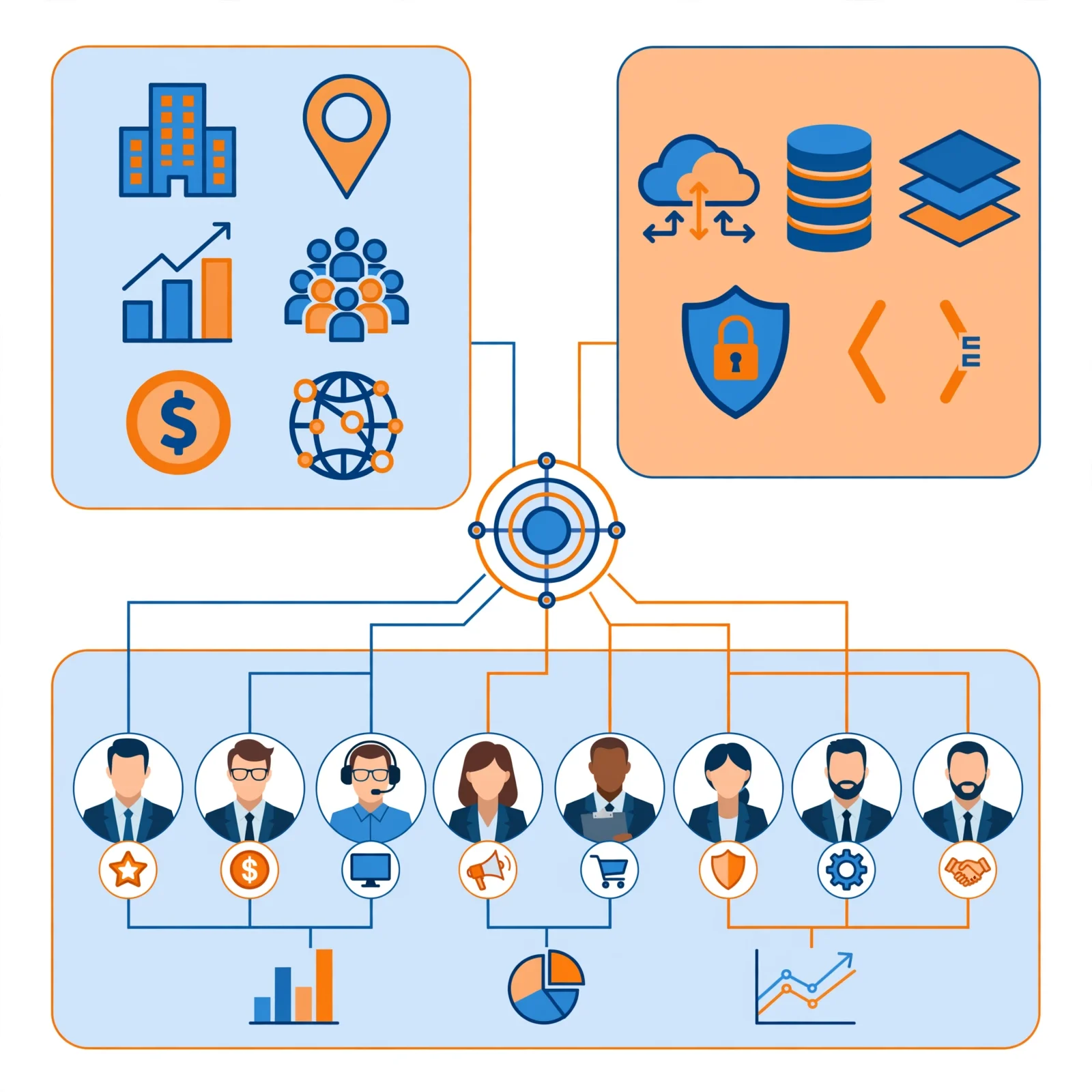
Building a rigorous ICP includes:
- Firmographic data: industry, company size, revenue, geography, growth stage.
- Technographic data: current tech stack, integrations, data infrastructure.
- Psychographic signals: strategic priorities, risk tolerance, innovation appetite.
- Behavioral indicators: content consumption patterns, event attendance, community engagement.
Beyond the ICP, map the buying committee. Enterprise B2B deals typically involve 6-10 stakeholders across IT, finance, operations, and the C-suite. Your demand generation content must speak to each of these roles at different stages of the funnel.
2. Full-Funnel Content Strategy
Content is the fuel that powers demand generation. But most B2B content programs suffer from the same structural flaw: they over-invest in mid-funnel conversion assets like case studies and whitepapers while neglecting the top-of-funnel content that creates demand in the first place.
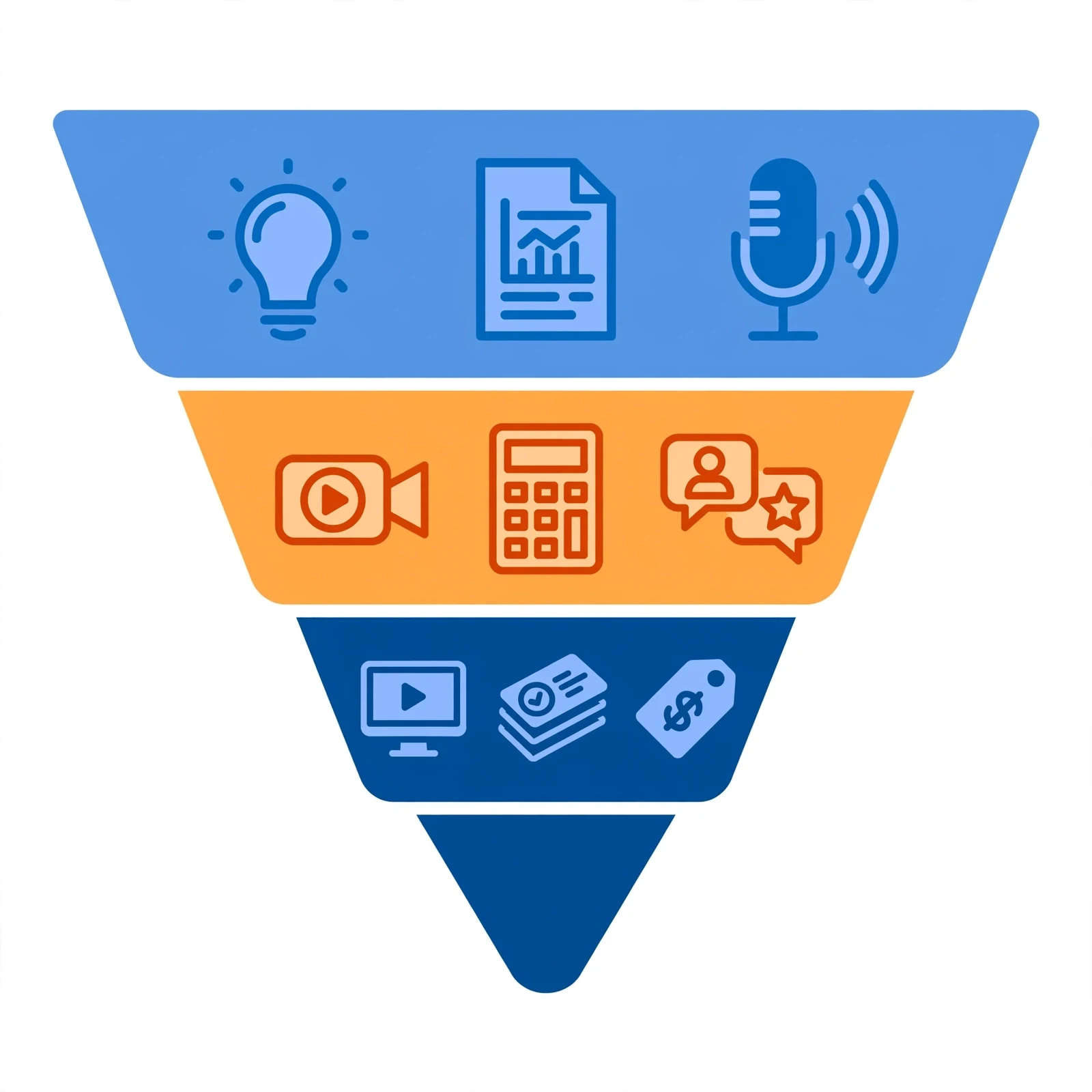
A balanced content architecture should include:
Top-of-Funnel (Awareness):
- Thought leadership articles and LinkedIn essays
- Industry trend reports and original research
- Podcast appearances and speaking engagements
- Comparison and category-defining content
Middle-of-Funnel (Consideration):
- Deep-dive use case content
- ROI calculators and interactive tools
- Webinars and virtual events
- Customer success narratives (non-gated)
Bottom-of-Funnel (Decision):
- Live demos and product walkthroughs
- Competitive battle cards (for sales enablement)
- Security documentation and compliance collateral
- Procurement-ready pricing frameworks
If you want to understand how inbound content fits into this broader architecture, our guide on B2B inbound marketing strategy explains the organic discovery layer in detail.
3. Multi-Channel Distribution and Paid Amplification
Creating exceptional content is only half the equation. You must distribute it strategically across the channels where your buyers actually spend their time. In B2B, this typically means:
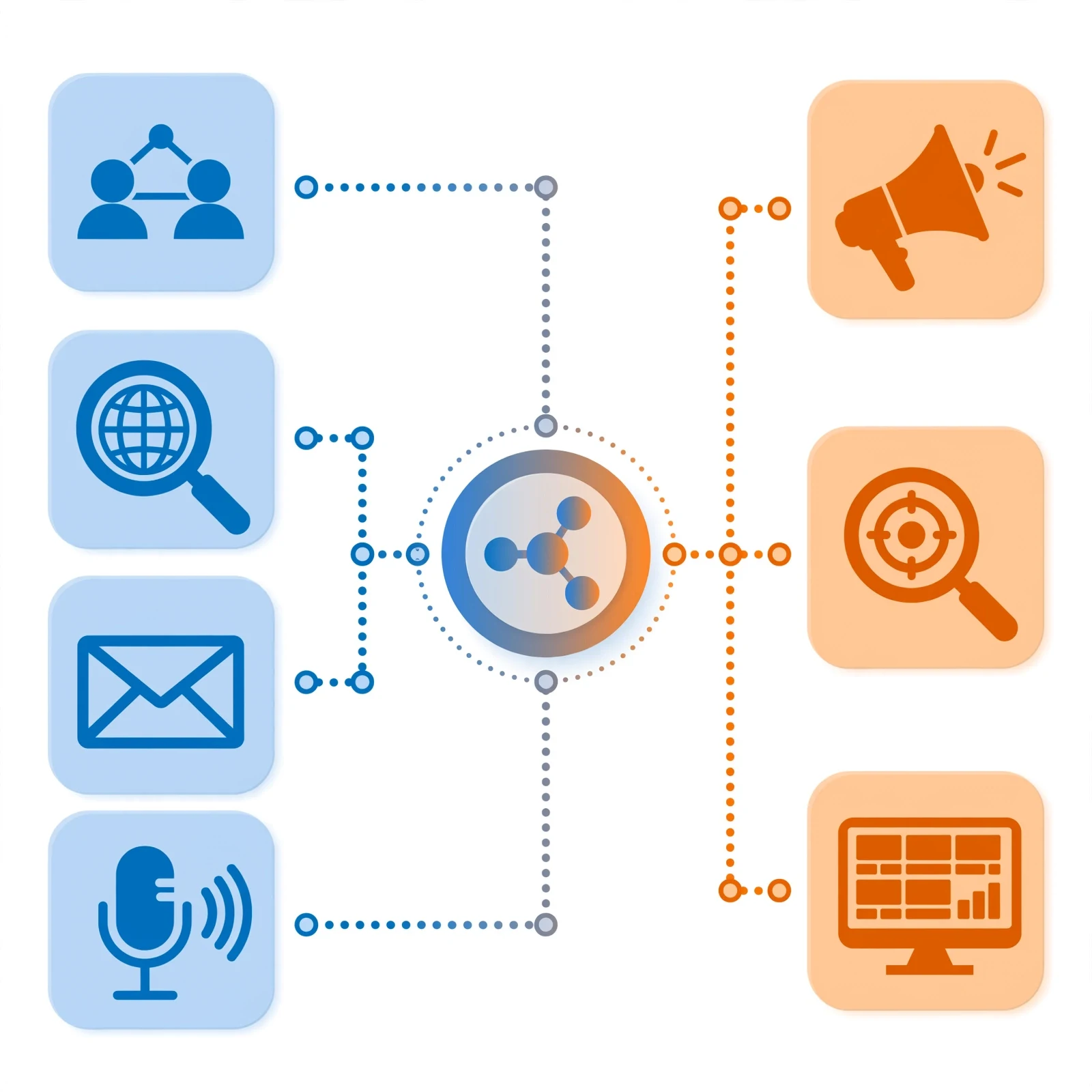
Organic Channels:
- LinkedIn: the highest-intent B2B professional network globally.
- SEO-driven blog content targeting problem-aware and solution-aware queries.
- Email newsletter programs for nurturing known audiences.
- Podcast and video content for community-driven authority.
Paid Channels:
- LinkedIn Sponsored Content and Message Ads for account-based targeting.
- Google Search and Performance Max for in-market, high-intent queries.
- Programmatic display for retargeting and ABM audience reinforcement.
- Podcast advertising and newsletter sponsorships for category awareness.
The most effective demand generation teams do not treat organic and paid as separate budget lines. They use organic content to validate messaging, then use paid amplification to accelerate distribution to precise audience segments.
4. Account-Based Marketing (ABM) Integration
Account-based marketing is not a replacement for demand generation. It is a precision layer that sits on top of it. Where broad demand generation builds category awareness and creates inbound pipeline, ABM focuses your resources on specific high-value accounts that match your ICP precisely.
A tiered ABM model typically looks like:
- Tier 1 – Strategic Accounts (1:1): Fully customized campaigns, personalized content, dedicated sales and marketing alignment. Typically 10-50 accounts.
- Tier 2 – Target Accounts (1:Few): Segment-specific messaging and content. Typically 50-200 accounts.
- Tier 3 – Programmatic ABM (1:Many): Scaled account targeting using intent data and behavioral signals. Typically 200-2,000+ accounts.
According to Demandbase’s B2B Go-to-Market Index, organizations that align ABM with their broader demand generation motion see significantly higher win rates and deal sizes compared to those running disconnected programs.
5. Revenue Operations Alignment and Attribution
Demand generation without measurement is brand spending disguised as marketing strategy. Your program needs a robust attribution model, clean CRM data, and alignment with your sales team on what constitutes pipeline-ready demand.
Key metrics to track across the demand generation funnel:
| Funnel Stage | Metric | Why It Matters |
|---|---|---|
| Awareness | Share of Voice, Branded Search Volume | Indicates market presence and category authority |
| Engagement | Content Engagement Rate, Email Open Rate | Measures content relevance and audience fit |
| Conversion | MQL to SQL Conversion Rate | Reveals alignment between marketing and sales |
| Pipeline | Pipeline Created, Pipeline Influenced | Connects marketing activity to revenue outcomes |
| Revenue | CAC, LTV:CAC Ratio, Revenue Influenced | Validates ROI of demand generation investment |
Building Your B2B Demand Generation Strategy: A Step-by-Step Framework
Step 1: Audit Your Current Demand Position
Before building, assess. Conduct a comprehensive audit of:
- Current organic search visibility and keyword rankings.
- Paid media spend efficiency by channel and campaign type.
- Content library gaps relative to buyer journey stages.
- CRM data quality and lead-to-opportunity conversion rates.
- Sales and marketing alignment on ICP and pipeline definitions.
Step 2: Define Your Demand Generation Goals and KPIs
Set specific, time-bound targets for each stage of the funnel. Avoid vanity metrics like page views and social impressions as primary KPIs. Focus on:
- Total pipeline generated by marketing.
- Percentage of pipeline sourced from inbound vs. outbound.
- Average days from first touch to opportunity creation.
- Cost per sales-qualified opportunity (CPSQO).
Step 3: Build Your ICP and Buying Committee Map
Use your best existing customers as the foundation. Interview them. Analyze their firmographic data. Map the roles involved in their buying process and identify the content each stakeholder consumed before signing.
Step 4: Develop Your Content Architecture
Map your content plan to the full buyer journey. Prioritize content types that address the questions your buyers are already asking during independent research phases. Include formats that work across channels: written, video, audio, and interactive.
Step 5: Select Your Channel Mix
Prioritize channels where your ICP is most active and where your budget can generate meaningful reach and frequency. For most B2B organizations, LinkedIn and organic search form the core, with paid amplification layered on top of proven organic content.
Step 6: Build Your Marketing Technology Stack
A functional demand generation stack typically includes:
- CRM: Salesforce, HubSpot, or equivalent.
- Marketing Automation: Marketo, HubSpot, Pardot.
- Intent Data: Bombora, G2 Buyer Intent, 6sense.
- ABM Platform: Demandbase, Terminus, or LinkedIn Campaign Manager.
- Analytics: Google Analytics 4, Looker, or equivalent BI tool.
Step 7: Launch, Measure, and Iterate
Demand generation is not a set-and-forget motion. Build a 90-day sprint cadence. Review performance weekly against your KPIs. Test messaging, creative, and audience segments systematically. Kill what does not work. Scale what does.
Common Demand Generation Mistakes B2B Marketers Make
Even experienced marketing teams fall into predictable traps. Avoid these critical errors:
Mistake 1: Gating Everything
Gating all content behind forms creates friction at the exact moment buyers are conducting independent research. Reserve gating for high-value, bottom-funnel assets. Give away your best thinking freely at the top of the funnel to build trust and authority.
Mistake 2: Misaligning Marketing and Sales on Pipeline Definitions
If marketing defines an MQL differently than sales defines a qualified opportunity, your entire funnel reporting is unreliable. Establish shared definitions in writing and review them quarterly
Mistake 3: Focusing Only on In-Market Buyers
Research from Ehrenberg-Bass Institute, cited widely in B2B strategy discussions, suggests that only about 5% of your total addressable market is actively in-market at any given time. A demand generation strategy that only targets in-market buyers ignores the 95% who will be buyers in future cycles.
Mistake 4: Neglecting Brand-Building in Favor of Performance Marketing
Performance marketing drives short-term pipeline. Brand-building drives long-term preference and lowers customer acquisition costs over time. The most effective B2B demand generation strategies invest in both simultaneously.
Mistake 5: Treating Demand Generation as a Campaign, Not a Program
A single campaign cannot build a sustained demand engine. Demand generation requires consistent investment in content, distribution, and optimization over multiple quarters to produce compounding returns.
Mistake 6: Ignoring the Buying Committee
Sending the same message to a CFO and a technical evaluator is a strategy that converts neither. Map your messaging to each stakeholder role and deliver it through the channels each persona actually uses.
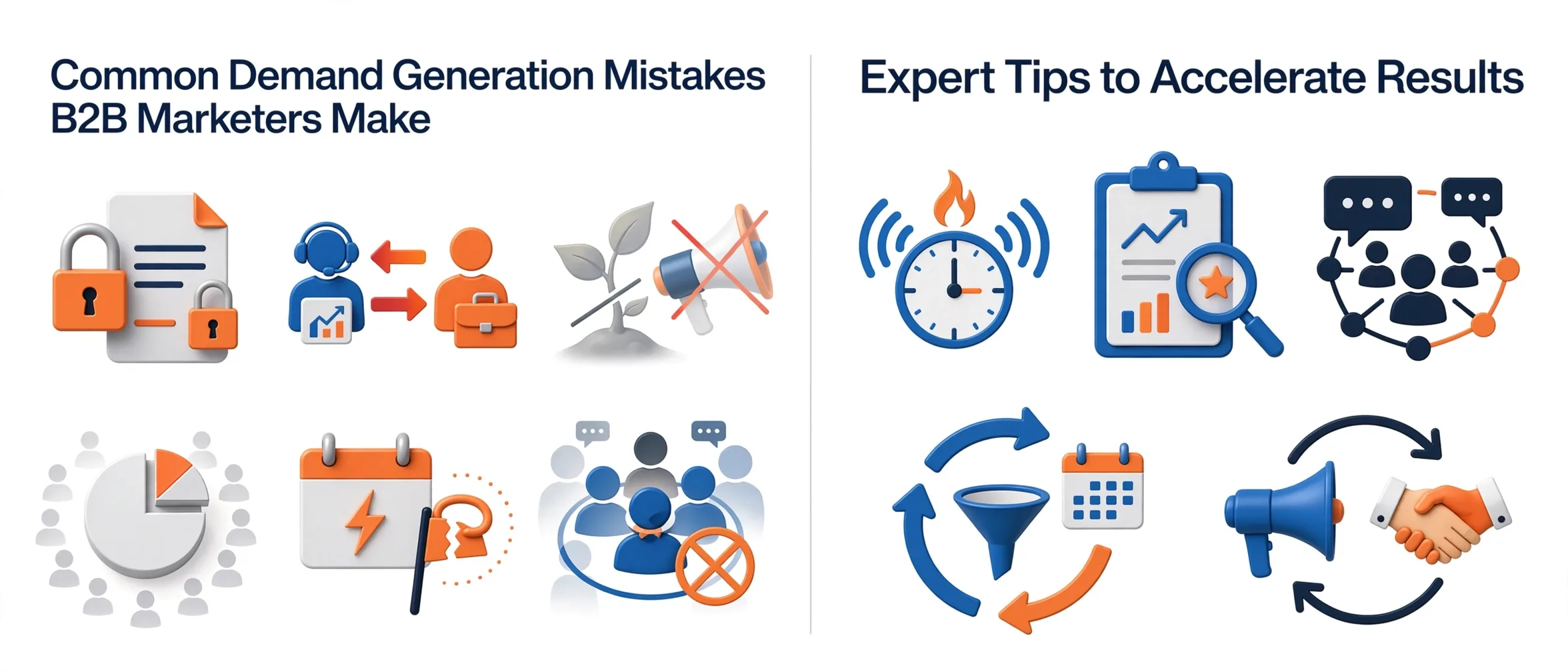
Expert Tips to Accelerate Your Demand Generation Results
Tip 1: Use Intent Data to Prioritize Outreach Timing
Intent data platforms like Bombora track when companies are actively researching topics related to your solution. Use these signals to prioritize outreach from your sales team, ensuring they engage high-intent accounts while purchase consideration is still active.
Tip 2: Invest in Original Research
First-party data and original research reports are among the highest-performing demand generation assets available to B2B marketers. They generate inbound backlinks, earn media coverage, and provide your sales team with credible, shareable content.
Tip 3: Build a Dark Social Content Strategy
Significant B2B buying influence happens in channels you cannot track directly: Slack communities, private LinkedIn groups, WhatsApp threads, and peer referrals. Invest in building genuine community presence in these spaces through thought leadership and relationship-building, not broadcasting.
Tip 4: Align Your Demand Generation Cadence to Sales Cycles
If your average sales cycle is six months, your demand generation program needs to build brand presence and nurture relationships well before a prospect enters an active buying cycle. Map your content cadence to your average time-to-close and work backwards.
Tip 5: Create a Feedback Loop Between Sales and Marketing
Your sales team hears objections, questions, and competitive comparisons every day. Those conversations are a goldmine for content ideas and messaging improvements. Build a structured process for capturing and acting on sales feedback in your demand generation program.
How to Measure the ROI of Your Demand Generation Strategy
Measuring demand generation ROI requires moving beyond last-touch attribution models. Modern revenue teams use multi-touch attribution to understand how different content and channels contribute across a long buying journey.
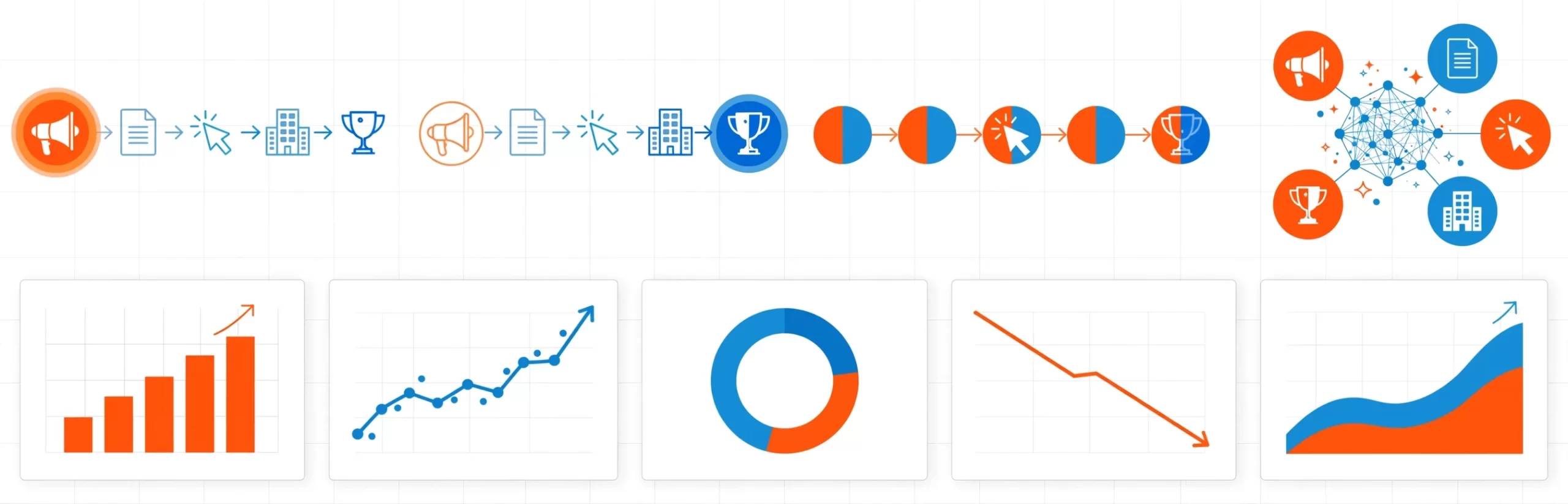
The four attribution models most relevant to B2B demand generation:
- First-Touch Attribution: Credits the first interaction that introduced the buyer to your brand. Useful for understanding which channels drive initial awareness.
- Last-Touch Attribution: Credits the final interaction before conversion. Useful for understanding what closes deals but undervalues awareness-building activities.
- Linear Attribution: Distributes credit equally across all touchpoints. Useful for understanding the full journey but not nuanced enough for optimization.
- Data-Driven Attribution: Uses machine learning to distribute credit based on actual contribution to conversion. The most accurate model for mature demand generation programs with sufficient data volume.
Regardless of the model you use, track these business-level outcomes to validate the ROI of your demand generation investment:
- Pipeline generated by marketing per quarter.
- Revenue closed from marketing-sourced pipeline.
- LTV:CAC ratio trend over 12-24 month periods.
- Reduction in average sales cycle length.
- Increase in average deal size from ICP accounts.
Frequently Asked Questions About B2B Demand Generation Strategy
Q1: What is a B2B demand generation strategy?
A B2B demand generation strategy is an integrated marketing framework designed to create awareness, build brand authority, and convert market interest into qualified sales pipeline. It spans the full buyer journey, from initial brand exposure through to sales-ready opportunity creation, and typically includes content marketing, paid media, account-based marketing, and revenue operations alignment.
Q2: How is demand generation different from lead generation in B2B?
Demand generation focuses on building category awareness and buyer preference across the entire market, including buyers who are not yet in an active buying cycle. Lead generation focuses on converting known, high-intent buyers into contacts. Effective B2B revenue programs integrate both: demand generation creates the market, and lead generation captures it.
Q3: What are the most important metrics for B2B demand generation?
The most important demand generation metrics are pipeline value generated, pipeline conversion rate from marketing-sourced leads, cost per sales-qualified opportunity, and revenue influenced by marketing. Vanity metrics like page views and social impressions are useful for directional insights but should not be primary KPIs.
Q4: How long does it take to see results from a B2B demand generation strategy?
Paid demand generation channels can begin generating pipeline within weeks. Organic and content-driven demand generation programs typically require 6-12 months to build meaningful search visibility and brand authority. The full compounding effect of an integrated demand generation strategy is usually visible at the 12-18 month mark, assuming consistent investment and optimization.
Q5: What is the role of ABM in a B2B demand generation strategy?
Account-based marketing (ABM) serves as the precision layer within a broader demand generation strategy. While demand generation builds category-wide awareness, ABM focuses resources on a defined list of high-value target accounts with personalized content, coordinated outreach, and customized buying experiences. The two motions are most effective when they run in parallel and share data.
Q6: How do I align sales and marketing around demand generation?
Alignment begins with shared definitions: agree on what constitutes a marketing-qualified lead, a sales-accepted lead, and a sales-qualified opportunity. Establish a shared pipeline dashboard that both teams review weekly. Build a formal feedback loop for sales to surface content gaps and messaging opportunities. And tie marketing KPIs to pipeline and revenue outcomes, not just activity metrics.
Q7: What content formats perform best for B2B demand generation?
The highest-performing formats vary by funnel stage. At the top of the funnel, thought leadership articles, LinkedIn content, and original research build awareness. In the consideration stage, webinars, use case content, and ROI tools drive engagement. At the decision stage, demos, customer stories, and competitive comparisons close pipeline. A strong B2B demand generation strategy uses all three layers.
Build a Demand Generation Strategy That Converts Pipeline Into Revenue
A high-performing B2B demand generation strategy is not built overnight. It is constructed methodically, tested continuously, and refined based on real pipeline and revenue data. The organizations that win in competitive B2B markets are not those with the biggest budgets. They are the ones that build the strongest market presence, the most trusted brand, and the most aligned revenue teams.
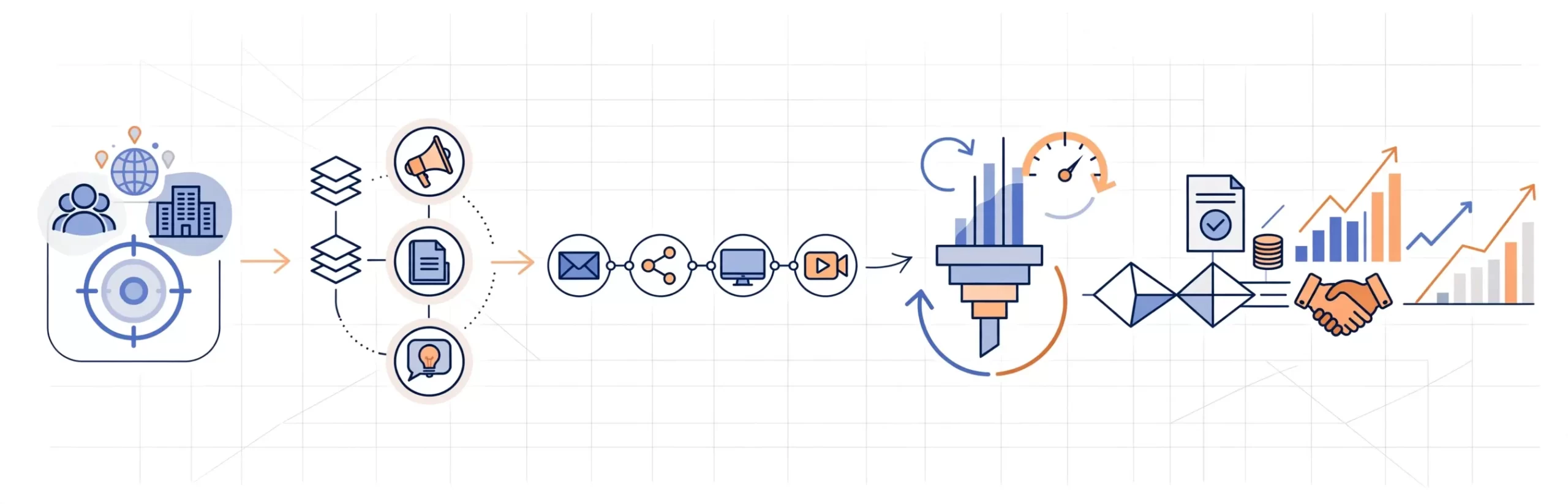
Start with your ICP. Build content that earns attention at every stage of the buyer journey. Distribute it where your buyers are. Measure what drives pipeline, not just what drives clicks. And iterate relentlessly.
If you are ready to build a demand generation engine that produces consistent, scalable pipeline, the team at AAMEK specializes in exactly this. Explore our full suite of B2B marketing services and demand generation programs designed to take you from market awareness to revenue.
For further reading on how demand generation intersects with inbound methodology, explore our in-depth resource on B2B inbound marketing strategy.
Pingback: B2B Content Strategy: Build Topical Authority Fast