
Healthcare SaaS marketing is the discipline of generating qualified pipeline for software sold to regulated provider, payer, and life sciences organizations, where HIPAA-aligned data handling, six-to-ten-person buying committees, and 9-18 month sales cycles shape every channel decision. Success depends on trust architecture first (security documentation, BAA readiness, clinical and financial proof), then on multi-threaded account engagement that keeps every stakeholder informed across a long, stall-prone evaluation. Marketers who treat compliance as a positioning asset, and pipeline as a committee-level metric, outperform teams that optimize for form fills and last-click attribution.
Selling into hospitals, health systems, and payers is a different game from standard SaaS growth. Buyers scrutinize security posture before features, and legal teams can pause a deal that marketing believed was closed. If your program relies on compliance-aware demand generation and pipeline architecture built for regulated buyers, you can shorten the gap between first touch and signed contract.
Key Takeaways: Healthcare SaaS Marketing at a Glance
- Compliance is a growth lever. Clear HIPAA, security, and BAA content removes objections early.
- Committees decide, not individuals. Typical complex B2B purchases involve roughly six to ten decision makers, according to Gartner research.
- Cycles are long, so nurture must be long. Plan 9-18 month programs for enterprise health system and payer deals.
- Measure accounts, not leads. Track engaged buying groups, stage progression, and influenced pipeline.
- Content must serve every role. Clinicians, IT, security, finance, and compliance each need different proof.
What is Healthcare SaaS Marketing?
Healthcare SaaS marketing is the set of strategies used to attract, educate, and convert healthcare organizations that buy cloud software. That software includes electronic health record (EHR) add-ons, revenue cycle tools, patient engagement platforms, clinical decision support, and analytics products.

In short, the definition rests on three conditions:
- Regulated buyers: Customers operate under HIPAA, state privacy laws, and often payer or accreditation standards.
- Complex buying groups: Clinical, operational, technical, and financial leaders all influence the decision.
- Extended timelines: Procurement, security review, and pilots stretch deals well beyond typical SaaS cycles.
Consequently, a healthcare SaaS marketing strategy must do more than generate awareness. It must build institutional trust, equip internal champions, and survive scrutiny from people who never fill out a form.
Who Buys Healthcare Software?
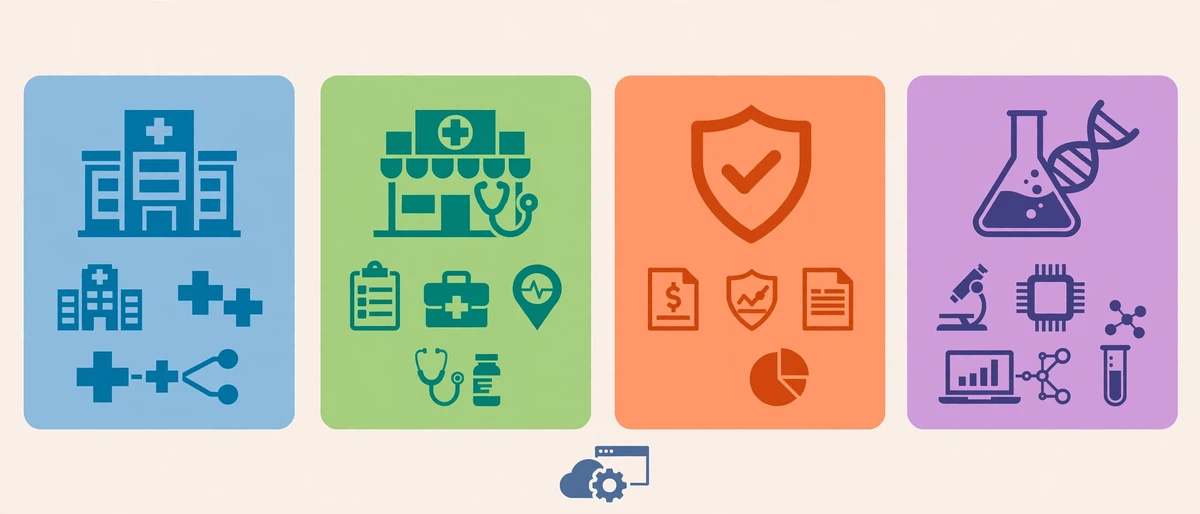
Most healthcare software buyers fall into four segments, and each behaves differently:
- Health systems and hospitals: Long cycles, formal RFPs, heavy security review.
- Physician groups and ambulatory practices: Shorter cycles, price sensitivity, workflow focus.
- Payers and health plans: Actuarial, compliance, and IT involvement, plus strict vendor management.
- Life sciences and digital health companies: Faster decisions, but strong regulatory and data governance needs.
How Healthcare SaaS Marketing Differs From Standard B2B SaaS
Standard SaaS playbooks assume fast trials, self-serve onboarding, and a small buying group. Healthcare breaks each of those assumptions. Therefore, copying a generic funnel usually produces plenty of top-of-funnel activity and very little closed revenue.
| Factor | Standard B2B SaaS | Healthcare SaaS |
|---|---|---|
| Average buying group | 3-6 stakeholders | 6-10+ stakeholders across clinical, IT, security, finance |
| Typical sales cycle | 1-6 months | 9-18 months for enterprise deals |
| Primary objection | Price and features | Security, HIPAA, clinical safety, integration |
| Required proof | Case studies, free trial | BAA, security questionnaires, peer references, outcomes data |
| Trial model | Self-serve trial | Guided pilot or sandbox with synthetic data |
| Content risk | Low | High: claims must be accurate and PHI must never appear |
| Best KPI | MQLs, trials | Engaged accounts, stage velocity, influenced pipeline |
HIPAA and Healthcare SaaS Marketing: What Marketers Must Know
HIPAA rarely restricts marketing to business contacts, yet it shapes almost everything around the marketing program: your product claims, your demo environments, your tracking stack, and your data handling. Marketers do not need to become lawyers. However, they must understand where the lines sit and involve counsel early.
Does HIPAA Apply to Your Marketing?
It depends on whether you handle protected health information (PHI). Under the HIPAA Privacy Rule, HHS guidance on marketing communications explains that communications encouraging recipients to buy or use a product generally require individual authorization when they rely on PHI, subject to defined exceptions.
In practice, here is how that plays out for SaaS vendors:
- Outreach to healthcare professionals at work: Business contact marketing does not use PHI, so the Privacy Rule marketing authorization requirement typically does not come into play. Standard email and privacy laws still apply.
- Patient-facing products: If your customers use your platform to communicate with patients, the marketing rules can affect what messages your product can send on their behalf.
- Business associate status: If your software creates, receives, maintains, or transmits PHI for a covered entity, you likely operate as a business associate. As a result, the Security Rule applies to you directly, as described in the HHS summary of the HIPAA Security Rule.
Business Associate Agreements as a Sales Asset
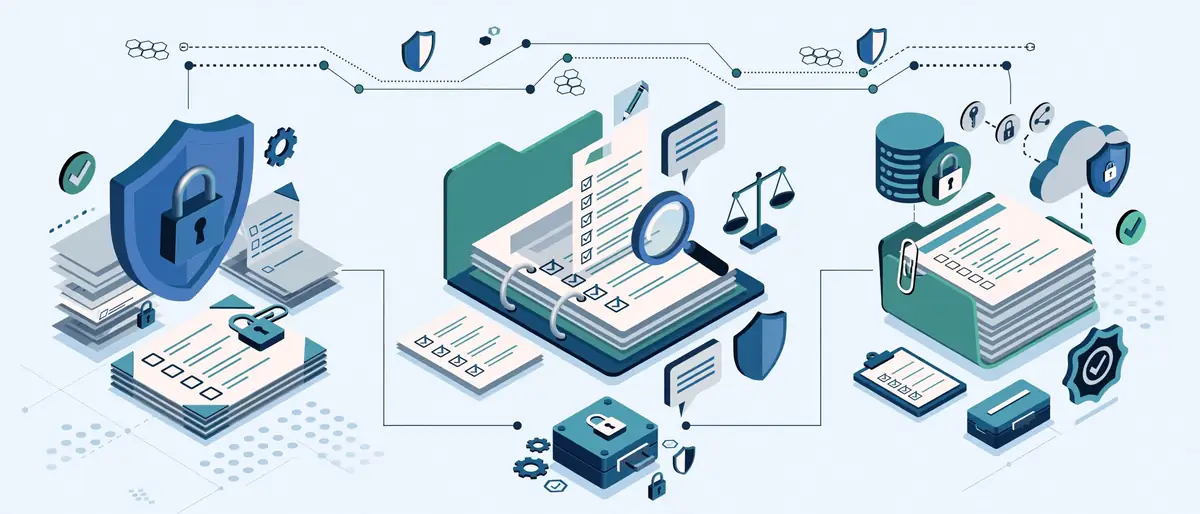
A business associate agreement (BAA) is a written contract that defines how PHI may be used and safeguarded. HHS explains that these contracts must establish permitted uses and disclosures and require appropriate safeguards, as outlined in its sample business associate contract provisions.
Many vendors hide this topic until legal review. Instead, surface it early:
- Publish a plain-language security and compliance page.
- State clearly whether you sign BAAs and what your standard process is.
- Prepare a security questionnaire pack (policies, architecture summary, incident response overview).
- Train sales and marketing to answer basic compliance questions without improvising.
Because buyers often start security review in parallel with clinical evaluation, this transparency removes weeks of friction.
HIPAA-Safe Marketing Operations Checklist
Use this checklist to keep your program defensible:
- Never collect PHI in web forms. Add clear field labels and warnings on contact and demo forms.
- Use synthetic data in demos and screenshots. Real patient information must never appear in creative assets.
- Audit tracking technologies. Review pixels, session replay, and analytics tools on any page that could touch PHI, especially authenticated or patient-facing areas. Regulatory guidance on online tracking has been subject to litigation, so confirm the current position with your counsel.
- Vet every marketing vendor. If a tool could touch PHI, confirm whether a BAA is required before deployment.
- Review claims for accuracy. Outcome, efficacy, and savings claims need documented sources.
- Document approvals. Keep a record of legal and compliance sign-off for key assets.
- Respect email and privacy law. Maintain consent records and honor opt-outs promptly.
Healthcare SaaS Marketing to Buying Committees
Gartner research widely cited across the industry indicates that a typical complex B2B purchase involves six to ten decision makers, each gathering information independently. Healthcare often skews larger because clinical, technical, and financial authority sit in separate departments.
As a result, one persuasive champion is not enough. Deals stall when a security officer, a finance leader, or a compliance lead meets your brand for the first time late in the process.
Map the Healthcare Buying Committee
Start by naming the roles you must reach. The following table shows a common structure, although titles vary by organization.
| Role | Typical Title | Core Question | Best Content |
|---|---|---|---|
| Clinical champion | CMIO, physician leader, nursing director | Will this improve care and fit our workflow? | Workflow demos, clinical outcomes, peer stories |
| Operational sponsor | COO, VP of operations | Will this reduce cost or friction? | ROI models, implementation timelines |
| Technical evaluator | CIO, IT director, integration lead | Does it integrate with our EHR and stack? | API docs, integration guides, architecture diagrams |
| Security and compliance | CISO, privacy officer | Can we trust this vendor with data? | Security whitepaper, BAA, audit reports, questionnaires |
| Financial approver | CFO, finance director | What is the total cost and payback? | Business case templates, pricing frameworks |
| Procurement | Sourcing or vendor management | Is the contract compliant and competitive? | Contract terms, references, vendor documentation |
| End users | Nurses, coders, front-desk staff | Will this make my day easier? | Training previews, short walkthroughs |
Build Content for Each Role
Generic thought leadership rarely persuades a CISO. Meanwhile, a clinical champion may ignore a technical spec sheet. Therefore, build a role-based content matrix:
- For clinicians: Short case studies, workflow videos, and evidence summaries.
- For IT: Integration documentation, uptime commitments, and interoperability details.
- For security: Control summaries, penetration testing overviews, and data flow diagrams.
- For finance: Cost models, implementation resource estimates, and payback scenarios.
- For procurement: Clear references, standard terms, and vendor risk documentation.
Use an Account-Based Approach to Multi-Threading
Because committees decide together, marketing should target accounts rather than isolated contacts. An account-based approach to multi-threading lets you coordinate ads, outreach, and content across every stakeholder at a target health system. Consequently, your sales team enters conversations where multiple people already recognize your brand.
A practical multi-threading routine looks like this:
- Identify 25-100 priority accounts using fit and intent signals.
- Map at least five stakeholder roles per account.
- Assign role-specific messages and assets.
- Coordinate paid, email, and sales touches into one sequence.
- Review engagement weekly and adjust.
Healthcare SaaS Marketing for 9-18 Month Sales Cycles
Long cycles change the marketing job. Instead of pushing prospects toward a quick decision, you must stay useful and visible for more than a year, without wearing out goodwill.
Why Healthcare Cycles Run So Long
Several factors stack together:
- Budget timing: Health systems plan capital and operating budgets on fixed calendars.
- Security and legal review: These reviews often run in parallel and frequently create delays.
- Clinical governance: Committees must approve workflow changes.
- Integration scoping: EHR and data connections require technical validation.
- Pilot and procurement steps: Even a promising pilot must pass contracting.
Note that many deals also stall because the buying group cannot agree internally. Your content can help by giving champions the language and evidence they need to build consensus.
Stage-Based Content Plan for Long Cycles
Match your assets to where the account sits, not to your campaign calendar.
| Stage | Approx. Timing | Buyer Goal | Marketing Focus | Example Assets |
|---|---|---|---|---|
| Problem awareness | Months 0-3 | Define the problem | Education and category framing | Research reports, webinars, benchmark guides |
| Solution exploration | Months 3-6 | Compare approaches | Differentiation and proof | Comparison guides, case studies, ROI calculators |
| Vendor evaluation | Months 6-12 | Shortlist and validate | Trust and risk reduction | Security pack, demos, reference calls |
| Consensus and business case | Months 9-15 | Align the committee | Champion enablement | Business case kit, executive briefs |
| Procurement and contracting | Months 12-18 | Approve and sign | Friction removal | Contract FAQs, implementation plan, legal documentation |
The demand generation motion that carries awareness into pipeline works best when each stage has its own content, owner, and success metric.
Nurture Without Nagging
A 12-month nurture program can feel repetitive fast. To avoid that, follow these rules:
- Vary formats: Rotate short videos, briefs, webinars, and peer stories.
- Trigger by behavior: Send security content after a pricing page visit, not on a fixed schedule.
- Give sales real reasons to reach out: Share new proof points, regulatory updates, or relevant benchmarks.
- Keep a human channel open: Personal notes and peer introductions often outperform automated sequences.
- Refresh regularly: Update stale statistics and case studies quarterly.
Measure What Matters in a Long Cycle
Last-click attribution fails when a deal spans a year and a dozen contacts. Track these signals instead:
- Account engagement score: Combined activity across all roles at an account.
- Committee coverage: Number of distinct roles engaged per target account.
- Stage velocity: Days between stages, compared by segment.
- Influenced pipeline: Opportunities where marketing touched at least one stakeholder.
- Stall rate: Deals with no meaningful activity for 30-45 days.
Step-by-Step Healthcare SaaS Marketing Framework
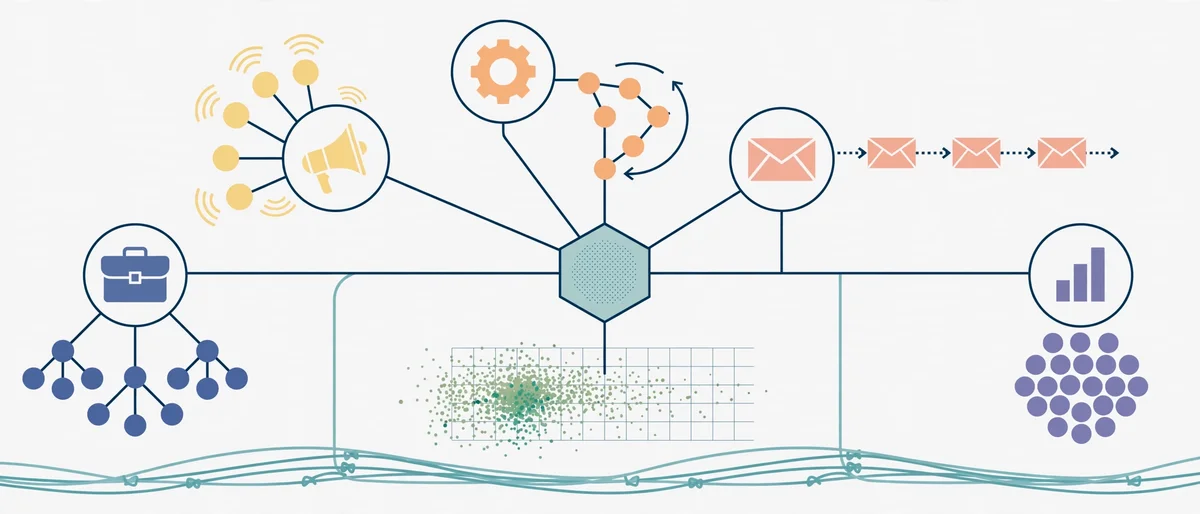
Use this seven-step framework to move from strategy to execution. Each step builds on the previous one.
- Define your compliance position. Decide whether you act as a business associate, document your safeguards, and prepare BAA and security materials.
- Choose a focused segment. Health systems, payers, and physician groups need different messaging. Start with one.
- Build an ideal account list. Combine firmographics (size, EHR platform, care setting) with intent and technographic signals.
- Map the committee. Identify roles, priorities, and objections for each target account type.
- Create a role-based content system. Publish education, proof, and risk-reduction assets for each stakeholder.
- Orchestrate multi-channel touchpoints. Coordinate SEO, paid, email, events, and sales outreach around accounts.
- Measure at the account level and iterate. Review committee coverage, velocity, and pipeline quality monthly.
Channels That Support Healthcare SaaS Marketing
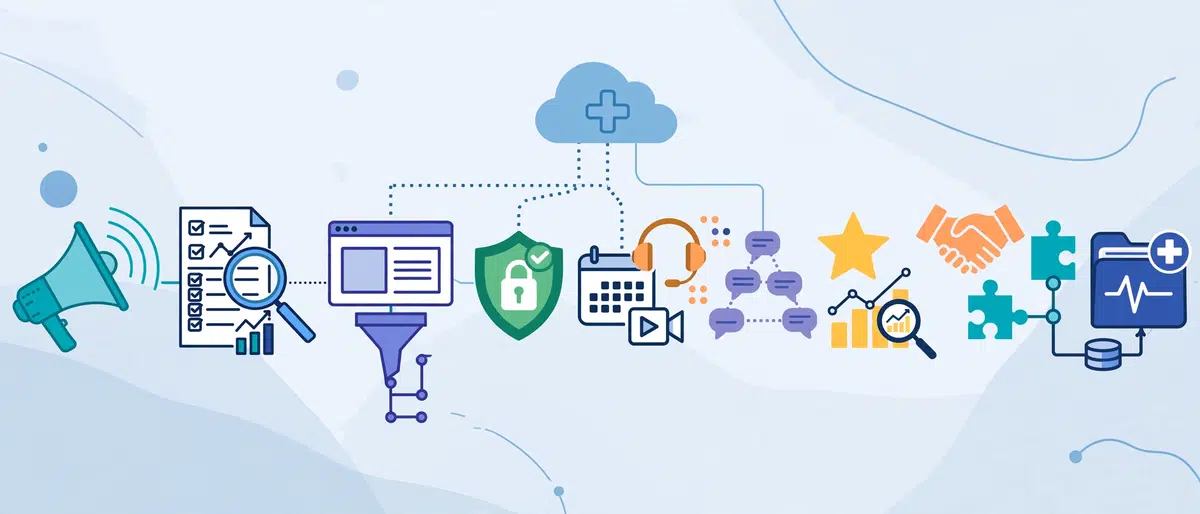
No single channel carries a long, complex sale. Instead, combine several that reinforce trust.
Search and Content
Buyers research heavily before speaking to sales. Compliance, integration, and workflow questions are prime search territory. Consequently, SEO programs tied to revenue rather than rankings help you capture demand from security officers, IT leaders, and clinicians who search for answers long before they request a demo.
To build durable visibility, build topical authority around compliance questions and clinical workflow topics. Cover each cluster in depth, cite authoritative sources, and show real expertise from named subject matter experts. Google’s people-first guidance rewards experience, expertise, and trust, and those qualities matter even more on health-related topics.
Landing Pages and Conversion Paths
Healthcare buyers rarely convert on a generic “Request a Demo” page. They want reassurance first. Build landing pages that answer security questions before the demo request, including badges only where you hold the certifications, links to your security overview, and clear data handling statements.
Events, Webinars, and Peer Communities
Trade conferences, clinician webinars, and peer roundtables remain influential because healthcare leaders trust colleagues. Feature customer voices, speak on operational problems instead of pitching, and follow up with role-specific resources.
Review Sites and Analyst Presence
Independent reviews, KLAS-style research, and analyst coverage often influence shortlists. Encourage satisfied customers to share feedback, and keep your profiles accurate.
Partnerships and Integrations
Integration with major EHR platforms and healthcare ecosystems carries strong signaling value. Publish integration pages, technical documentation, and co-marketing assets so IT evaluators can validate fit quickly.
Common Healthcare SaaS Marketing Mistakes
Avoid these frequent errors:
- Ignoring compliance in messaging: Vague statements about security invite doubt. Be specific and accurate.
- Targeting only the champion: Deals stall when other committee members remain unconvinced.
- Using real patient data in assets: Screenshots and demos must use synthetic data.
- Overclaiming outcomes: Unsupported ROI or clinical claims damage credibility and create legal risk.
- Measuring form fills: High lead volume with low committee engagement rarely produces revenue.
- Ending nurture at the demo: The longest, riskiest stretch comes after the demo.
- Publishing thin content: Generic articles do not earn trust from expert audiences and risk poor search performance.
- Letting sales and marketing operate separately: Misaligned handoffs cost months in long cycles.
Expert Tips for Healthcare SaaS Marketing
- Lead with a compliance narrative. Frame security and privacy as evidence of maturity, not fine print.
- Equip the champion. Provide a ready-made internal pitch deck, one-page summary, and objection guide.
- Interview real experts. Clinical advisors and security leaders add credibility that anonymous copy cannot match.
- Show implementation clarity. Buyers fear disruption, so publish realistic timelines and staffing expectations.
- Build a proof library. Keep short, sourced outcome stories organized by segment, role, and use case.
- Plan for AI search. Write direct, well-structured answers that summarize your position, then support them with depth and citations.
- Review content quarterly. Regulations, standards, and product details change; outdated pages lose trust quickly.
Quick Answers: Healthcare SaaS Marketing Essentials
What is the main goal of healthcare SaaS marketing? The goal is to build trust and consensus across a regulated buying committee so qualified accounts move through a long evaluation and sign.
How many people are in a healthcare software buying committee? Complex B2B purchases commonly involve six to ten decision makers, and healthcare deals often reach the upper end or beyond because clinical, IT, security, and finance leaders all participate.
How long is a healthcare SaaS sales cycle? Enterprise health system and payer deals frequently run 9-18 months, while smaller practice deals close faster.
Frequently Asked Questions About Healthcare SaaS Marketing
What is healthcare SaaS marketing?
Healthcare SaaS marketing is the practice of promoting cloud software to healthcare organizations such as hospitals, health systems, payers, and physician groups. It combines standard B2B demand generation with HIPAA awareness, multi-stakeholder engagement, and long-cycle nurture.
Is HIPAA relevant to healthcare SaaS marketing?
Yes, although in different ways depending on your model. Marketing to healthcare professionals at work generally does not involve PHI. However, if your platform handles PHI you probably act as a business associate, so security safeguards, BAAs, and careful handling of forms, demos, and tracking tools all matter. Confirm details with qualified counsel.
How do you market to a healthcare buying committee?
Map every role, from clinical champions to security and procurement, and create content for each concern. Then coordinate account-based touchpoints so multiple stakeholders receive consistent, relevant messages throughout the evaluation.
Why are healthcare SaaS sales cycles so long?
Budget calendars, security and legal reviews, clinical governance, integration scoping, and procurement all add time. Internal consensus building also slows decisions, which is why champion enablement content is so valuable.
Which healthcare SaaS marketing channels work best?
Search-driven content, account-based outreach, webinars, events, review sites, and integration partnerships tend to work best in combination. The right mix depends on your segment, deal size, and how buyers research vendors.
How should you measure healthcare SaaS marketing performance?
Track account engagement, committee coverage, stage velocity, and influenced pipeline. These metrics reflect how long, multi-threaded deals actually progress, unlike lead volume alone.
Can a healthcare SaaS company use case studies and testimonials?
Yes, provided you have written customer permission, verify every claim, and avoid any patient-identifiable information. Compliance and legal review should approve outcome statements before publication.
Conclusion: Turning Healthcare SaaS Marketing Into Predictable Pipeline
Healthcare SaaS marketing rewards patience, precision, and proof. Compliance clarity earns the first meeting, committee-level engagement carries the deal through review, and stage-based nurture keeps momentum across a 9-18 month journey. Teams that align these three elements stop chasing leads and start managing accounts.

If you want a partner that understands regulated, multi-stakeholder pipelines, book a healthcare SaaS pipeline strategy session with AAMEK and turn a long sales cycle into a measurable growth engine.